Case Study: 4-Color Label Flexo Machine Test & Delivery
For industrial converters, the transition from an equipment purchase to active production depends on a verified proof of concept. In this case study, we document the technical commissioning of a 4-color label flexo printing machine tailored for a client's specific pharmaceutical label requirements.
1. Artwork Validation and Pre-press Optimization
The project commenced with the client providing high-resolution original artwork. Our engineering team performed a digital pre-flight check to align the design with the mechanical capabilities of the 4-color flexo process. Key adjustments included:
- Trap Settings: Optimization of overlaps to prevent white gaps during high-speed runs.
- Dot Gain Compensation: Adjusting the highlight and shadow areas to account for the specific plate hardness.
- LPI Matching: Selecting Anilox rollers with the correct line count to match the fine-text requirements of the labels.
2. Substrate Physics: BOPP Film Adhesion Testing
The client utilized a localized BOPP (Biaxially Oriented Polypropylene) film. Because synthetic films are non-porous, ink adhesion is the primary technical hurdle. We conducted a series of laboratory tests before full-scale production:
- Dyne Level Measurement: We utilized test pens to verify the substrate’s surface energy. A minimum of 38-40 mN/m was maintained via integrated Corona Treatment to ensure permanent ink bonding.
- Tension Mapping: Analyzing the material's elasticity to calibrate the machine’s automatic tension control systems.
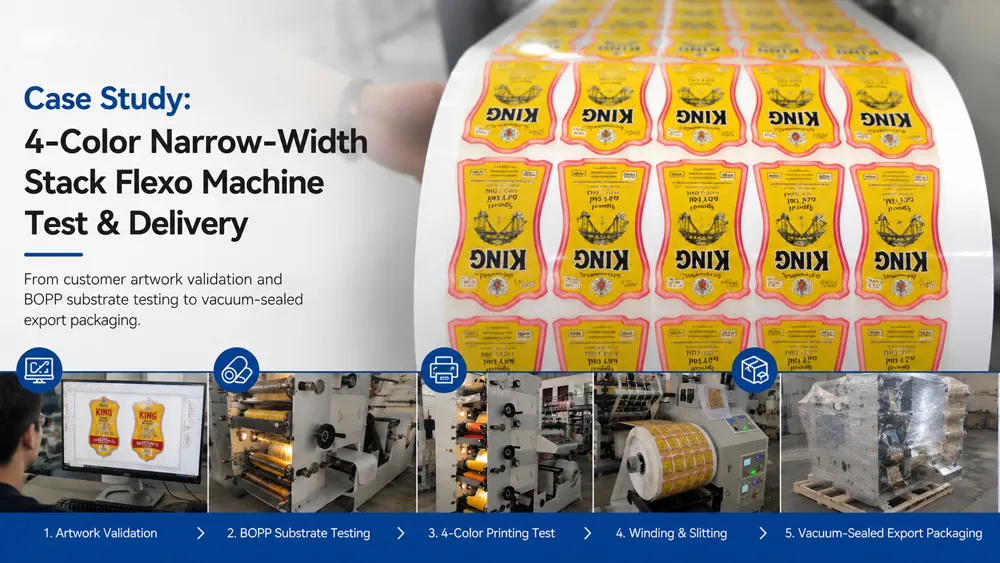
3. 4-Color Flexo Debugging: Achieving Precision Registration
The core of the commissioning phase involved calibrating the servo-driven registration system. For 4-color CMYK printing, even a 0.1mm drift can result in blurred imagery. Our engineers utilized the following precision model to audit the registration stability:
$$E_{reg} = \sqrt{\Delta x^2 + \Delta y^2} \leq 0.08mm$$
By synchronizing the independent motors for each color station via high-speed fiber optics, we achieved a stable "Kiss-Touch" impression at a production speed of 120m/min.
4. Quality Audit: Final Print Performance
Once debugging was completed, a 3,000-meter test run was performed. The final audit focused on color saturation and opacity. The results confirmed:
| Technical Metric | Client Standard | Henghao Test Result |
|---|---|---|
| Registration Error | < 0.15mm | 0.08mm |
| Ink Adhesion (Tape Test) | No Flaking | Pass (100% Bond) |
| Color Consistency (ΔE) | < 2.0 | 1.4 |
5. Export Standardization: Packaging and Shipping
After the client approved the final test video and samples, the machine entered our export preparation phase. A packaging printing machine requires rigorous protection against the high-humidity environment of sea freight:
- Rust Inhibition: All precision components and rollers were treated with professional-grade anti-corrosion oil.
- Vacuum Sealing: The entire unit was sealed in heavy-duty vacuum film to eliminate oxygen and moisture.
- ISPM-15 Compliance: The machine was secured in a steel-reinforced wooden crate, meeting all international phytosanitary and safety standards for global logistics.
Conclusion
This case study demonstrates the Henghao technical workflow: from artwork optimization and substrate science to precision engineering and secure global delivery. By bridging the gap between mechanical hardware and print performance, we ensure that every flexo printing machine is ready for immediate, profitable production upon arrival at the client’s facility.
Share this article: