Die Cutting vs Punching: Process, Materials & Uses
Die cutting and punching are both material-cutting processes, but they serve different production purposes. Die cutting is commonly used to create complete product outlines, label shapes and packaging blanks, while punching is generally used to produce holes, slots and localized cutouts.
However, these processes can overlap. Punch-and-die tooling can also produce complete contours, so the correct choice depends on the cutting geometry, material, tooling arrangement and required production output.
This guide compares die cutting vs punching for label converters, packaging manufacturers and industrial buyers, covering process differences, materials, applications, precision and production costs.
Choose die cutting when you need to produce complete shapes, custom label outlines or packaging blanks. Choose punching when the primary operation is creating holes, slots or localized openings. For complex industrial products, a punch-and-die system may perform both types of cutting.
Die Cutting vs Punching: Key Differences
The main difference is the intended cutting operation and tooling arrangement. The following table provides a direct comparison.
| Comparison Factor | Die Cutting | Punching |
|---|---|---|
| Primary Purpose | Creates complete product outlines, labels and packaging blanks. | Creates holes, slots and localized cutouts. |
| Cutting Method | Uses shaped cutting dies to follow a defined outline. | Uses a punch and matching die to shear material. |
| Typical Geometry | Custom contours, curves and repeated product shapes. | Round holes, slots, openings and shaped cutouts. |
| Tooling | Rotary dies, flatbed dies and other shaped cutting tools. | Punches and matching die openings. |
| Precision | Depends on die quality, machine control and material stability. | Depends on punch clearance, alignment and material properties. |
| Materials | Paper, paperboard, adhesive labels, plastic films and laminates. | Paper, plastic films, sheet metal and other compatible materials. |
| Production Format | Roll-to-roll, sheet-fed and intermittent processing. | Sheet-fed, press-based and integrated web processing. |
| Typical Applications | Labels, packaging blanks, paper cup fans and shaped components. | Hanging holes, handle slots, ventilation holes and positioning openings. |
Die Cutting
Main function: Producing the required external shape or contour of a finished product.
Typical examples include self-adhesive labels, paper cup fan blanks, folding carton shapes and custom packaging components.
Punching
Main function: Producing holes, slots or localized openings through a material.
Typical examples include retail packaging hanging holes, bag handle openings, ventilation holes and positioning holes.

What Is Die Cutting?
Die cutting is a manufacturing process that uses a shaped cutting tool to cut, score, perforate or partially cut material into a specified design. It is widely used in label converting, paper packaging, flexible materials and industrial component production.
Rotary Die Cutting
Uses a rotating cylindrical die to process continuous material webs. It is commonly used for roll labels and high-volume converting operations.
Flatbed Die Cutting
Uses a flat cutting tool and reciprocating press action. It can process sheets or intermittent web materials depending on machine configuration.
Kiss Cutting
Cuts the label face stock and adhesive while leaving the release liner substantially intact. It is commonly used for self-adhesive labels.
Through Cutting
Cuts completely through the intended material layers to separate finished shapes, blanks or individual components.
The selected tooling and machine configuration determine which operations can be performed. Not every die-cutting machine supports all cutting methods.
For a more detailed explanation of label converting, see our guide to the label die cutting process.
What Is Punching?
Punching is a cutting operation in which a punch and matching die shear material to create a hole, slot or shaped opening. The material between the punch and die is separated through controlled cutting force, and the removed piece is commonly called a slug.
The basic punching process involves:
- Material positioning: The material is aligned with the required hole or cutout location.
- Punch engagement: The punch moves toward the matching die opening.
- Material shearing: The punch separates the material along the required geometry.
- Slug removal: The removed material is discharged or collected to prevent interference with subsequent operations.
Punching is widely used in sheet metal fabrication, paper converting, plastic packaging and other industrial applications.
Punching is not necessarily slower, less accurate or limited to simple holes. With suitable tooling, punch-and-die systems can produce complex openings and complete product contours. In some industrial applications, punching and die cutting describe overlapping operations rather than completely separate technologies.
Hole Punching vs Contour Cutting: What Is the Difference?
One of the most practical ways to distinguish punching from die cutting is to look at the required cutting geometry.
Hole Punching
Removes material from a specified location to create round holes, slots or openings.
Examples: Euro holes, bag handles, ventilation holes and positioning holes.
Contour Cutting
Follows the external boundary of a design to separate a complete product shape from the surrounding material.
Examples: Custom labels, paper cup fans, packaging blanks and shaped components.
| Factor | Hole Punching | Contour Cutting |
|---|---|---|
| Cutting Objective | Create holes and localized openings. | Produce complete external shapes. |
| Cutting Position | Usually within the material area. | Along the product boundary. |
| Typical Geometry | Round, oval, rectangular or custom openings. | Curves, irregular outlines and repeated shapes. |
| Key Quality Checks | Hole diameter, position, edge condition and slug removal. | Finished dimensions, cutting continuity and edge quality. |
Which Materials Can Be Die Cut or Punched?
Both processes can handle a variety of materials, but the correct tooling and machine configuration depend on material thickness, stiffness, flexibility, layer construction and cutting geometry.
| Material | Die Cutting | Punching | Important Considerations |
|---|---|---|---|
| Paper | Suitable | Suitable | GSM, feeding stability and edge quality. |
| Paperboard | Suitable | Suitable | Thickness, cutting force and tooling. |
| Self-Adhesive Labels | Suitable | Suitable for appropriate openings | Adhesive behavior, liner integrity and waste removal. |
| PP / PE / PET Films | Suitable | Suitable | Film deformation, thickness and clean edges. |
| Laminated Films | Suitable with compatible tooling | Suitable with compatible tooling | Layer separation, bonding and edge quality. |
| Sheet Metal | Depends on tooling and machine design | Common application | Material grade, thickness, punch clearance and cutting force. |
Material compatibility should always be verified using the actual production material. A process that works well with paper may require a different tooling arrangement for adhesive films or laminated structures.
Applications of Die Cutting and Punching in Labels and Packaging
Different packaging products require different cutting operations. The following examples illustrate how buyers can match the cutting process to the finished product.
Self-Adhesive Label Production
Label production commonly uses kiss cutting to create the finished label shape without cutting through the release liner. Rotary and flatbed systems can perform this operation when equipped with suitable tooling, pressure control and waste removal systems.
Manufacturers producing roll labels can explore label die cutting machines designed for different materials, shapes and converting workflows.
Paper Cup Fans and Packaging Blanks
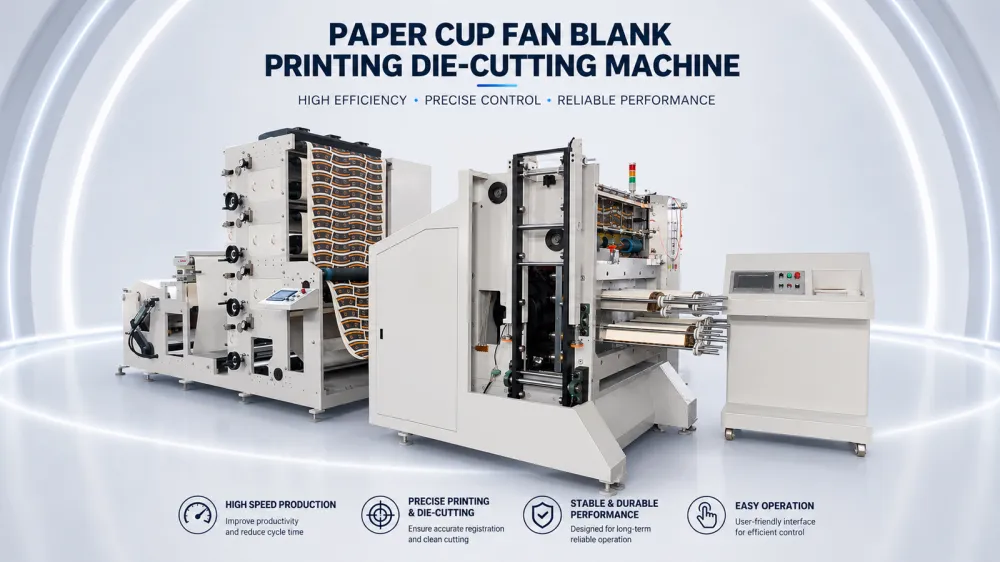
Paper cup production requires accurately shaped fan blanks that can be transferred to the cup-forming process. Some machines use punch-and-die mechanisms to cut these blanks in a continuous production workflow.
This application demonstrates why punching and die cutting can overlap in industrial terminology. The important purchasing considerations are blank dimensions, paper thickness, coating, cutting layout and compatibility with downstream forming equipment.
Packaging Bags and Hanging Holes
Retail bags and flexible packaging may require round holes, Euro slots or handle openings. A dedicated punching unit can be practical when the main task is creating localized openings rather than cutting the complete package outline.
For laminated films, the punching method must also account for material thickness, layer structure, edge quality and reliable slug removal.
What Affects Cutting Precision and Production Output?
Cutting quality depends on more than whether a process is called die cutting or punching. Tooling condition, machine stability, material properties and feeding accuracy all influence the finished result.
| Production Factor | Why It Matters | What Buyers Should Check |
|---|---|---|
| Material Thickness | Influences cutting force, tooling clearance and edge quality. | Actual material thickness and consistency. |
| Tool Alignment | Affects dimensional consistency and tool wear. | Cutting alignment and repeatability. |
| Cutting Geometry | Determines tooling complexity and material utilization. | Small details, corners and hole positions. |
| Feeding Accuracy | Important for registered cutting of preprinted materials. | Web guiding, feeding stability and registration. |
| Production Speed | Must be evaluated together with finished-product quality. | Acceptable output under actual operating conditions. |
| Waste Removal | Prevents slugs, trim and matrix waste from interrupting production. | Waste stripping and collection reliability. |
Do Not Compare Machine Speed Using Different Units
Rotary web systems may be rated in meters per minute, while reciprocating equipment may be rated in strokes per minute. Neither figure alone establishes the number of acceptable finished products.
For purchasing decisions, compare the actual number of accepted finished pieces per hour under the same material, product layout and quality requirements.
Die Cutting vs Punching: Cost Factors
The total cost depends on tooling, changeovers, output, waste and maintenance rather than simply whether the machine is called a die cutter or punching machine.
| Cost Factor | What Buyers Should Evaluate |
|---|---|
| Initial Equipment | Machine structure, feeding system, automation and optional functions. |
| Tooling | Die or punch cost, number of shapes and replacement requirements. |
| Changeover | Time required to replace tooling and adjust machine settings. |
| Material Waste | Blank layout, trim width, slug removal and rejected products. |
| Operating Cost | Labor, electricity, tooling wear and maintenance. |
| Saleable Output | Accepted finished pieces per hour after downtime and rejects. |
A useful comparison is the total converting cost per acceptable finished piece:
(Material + Labor + Energy + Tooling Allocation + Maintenance + Other Production Costs) / Acceptable Finished Pieces
For short runs with frequent design changes, tooling expense and setup time may be especially important. For repeat orders, stable output, material utilization and downtime can have a greater effect on long-term cost.
Which Process Should You Choose?
Start with the finished product and required cutting operation. Use the following guide to identify the most suitable processing approach.
| Production Requirement | Likely Approach | What to Confirm |
|---|---|---|
| Custom-shaped adhesive labels | Rotary or flatbed die cutting | Kiss-cut depth, registration and matrix stripping. |
| Round holes or hanging slots | Punching unit | Hole geometry, edge quality and slug removal. |
| Paper cup fan blanks | Punch-and-die cutting system | Blank layout, coating, cutting area and forming compatibility. |
| Continuous roll-label converting | Suitable rotary die-cutting configuration | Web width, repeat length, tooling and rewinding. |
| Multiple shapes and frequent job changes | Compare flatbed, semi-rotary and other suitable systems | Tooling flexibility, setup time and total operating cost. |
What Should Buyers Include in an RFQ?
Before requesting a quotation, prepare the following information:
- Material: Paper, paperboard, self-adhesive stock, film or laminate.
- Thickness: Material thickness or GSM, including coatings and additional layers.
- Cutting Drawing: Finished dimensions, shape, hole locations and required tolerances.
- Production Format: Roll-to-roll, roll-to-sheet or sheet-fed operation.
- Output Target: Required acceptable pieces per hour and typical order quantities.
- Job Changes: Number of designs, tooling sets and expected changeover frequency.
- Finishing: Waste stripping, slitting, rewinding, stacking or downstream equipment integration.
Comparing Label Die Cutting Machine Configurations
For label converters, machine configuration should match the required label format, material, cutting method and finishing workflow. These two equipment configurations illustrate different approaches to label converting.
Compare actual cutting samples, tooling requirements, changeover procedures and finished-roll specifications before selecting a machine.
Die Cutting vs Punching FAQ
Is Punching a Type of Die Cutting?
In some manufacturing contexts, yes. Punching uses a punch-and-die arrangement, and certain industrial cutting systems combine both operations. The distinction depends on the tooling and intended cutting function.
Can Punching Create Complex Shapes?
Yes. Suitable punch-and-die tooling can produce shaped openings and contours. Tool design, cutting force, material properties and part geometry determine the practical limits.
Does Die Cutting Always Produce Less Waste?
No. Waste depends on material layout, cutting geometry, material width and scrap removal. A well-optimized punching layout may use less material than a poorly planned die-cutting layout, or vice versa.
Can Die Cutting and Punching Be Combined in One Production Line?
Yes. Some converting lines combine contour cutting, hole punching, perforation, slitting and other finishing operations. Available functions depend on machine design and tooling.
Should Buyers Test Their Materials Before Ordering Equipment?
Preferably, yes. A sample trial can help verify cut quality, dimensional consistency, waste removal and stable production using the intended material and cutting design.
Conclusion: Choose the Cutting Process by Application
Die cutting is generally the preferred approach for producing complete product shapes, labels and packaging blanks, while punching is commonly used for holes, slots and localized openings.
However, the two processes can overlap in industrial production. A punch-and-die system may also produce complete product contours, depending on the tooling arrangement.
Before investing in equipment, evaluate the material, cutting geometry, tooling costs, production format and acceptable finished output. Requesting a sample trial using the actual production material is one of the most practical ways to confirm equipment suitability.
Share this article: