Top 10 Flexo Printing Machine Manufacturers (2026): Compare Global Brands Before You Buy
Choosing a flexo printing machine manufacturer starts with your application—not the brand name. A label converter, flexible packaging producer, paper cup factory and distributor may need very different press architectures, automation levels and converting functions.
This guide compares 10 flexo printing machine manufacturers by their main market focus and typical applications, then explains what buyers should verify before requesting quotations.
Quick Answer: Which Flexo Printing Machine Manufacturer Should You Choose?
Choose manufacturers with proven machine platforms for your substrate, finished product, printing width, colors, production volume and converting process. Large flexible-packaging converters may focus on industrial CI flexo suppliers, while label and paper-product producers may require narrow-web, Inline or Stack configurations.
If you are still defining the machine type, compare the available flexo printing machine configurations before building your manufacturer shortlist.
Top 10 Flexo Printing Machine Manufacturers at a Glance
| Manufacturer | Country | Main Flexo Focus | Typical Buyer / Application |
|---|---|---|---|
| BOBST | Switzerland | Industrial packaging printing | Large flexible-packaging converters |
| Windmöller & Hölscher | Germany | High-performance flexible packaging | Large film and packaging plants |
| Mark Andy | USA | Narrow-web labels | Label converters |
| Comexi | Spain | Flexible packaging | Packaging converters |
| Uteco | Italy | Flexible packaging printing | Medium and large converters |
| Nilpeter | Denmark | Narrow-web labels | Label and specialty converters |
| Edale | United Kingdom | Labels and paperboard | Label and carton converters |
| Gallus | Switzerland | Label production | Label converters |
| ZONBON Machinery | China | Configurable flexo solutions | Packaging converters and international buyers |
| Henghao Machinery | China | Stack and Inline flexo | Labels, paper products and customized applications |
This table is not a universal performance ranking. These manufacturers serve different market segments, so buyers should first identify the relevant machine category and then compare suppliers within that category.
Choose the Manufacturer by What You Need to Print
| Your Product | Press Direction to Evaluate | Key Buying Factors |
|---|---|---|
| Self-adhesive labels | Narrow-web / Inline / suitable Stack configuration | Registration, substrate range, drying and finishing |
| Flexible packaging film | CI or suitable wide-web flexo | Tension, drying, stable speed and waste |
| Paper cups | Stack / Inline depending on workflow | PE-coated paper, width, colors, drying and downstream converting |
| Paper bags / kraft paper | Stack or suitable roll-to-roll flexo | Paper GSM, width, colors and production output |
| Premium labels | Inline / narrow-web | Finishing, die cutting, varnishing, foil and job changeover |
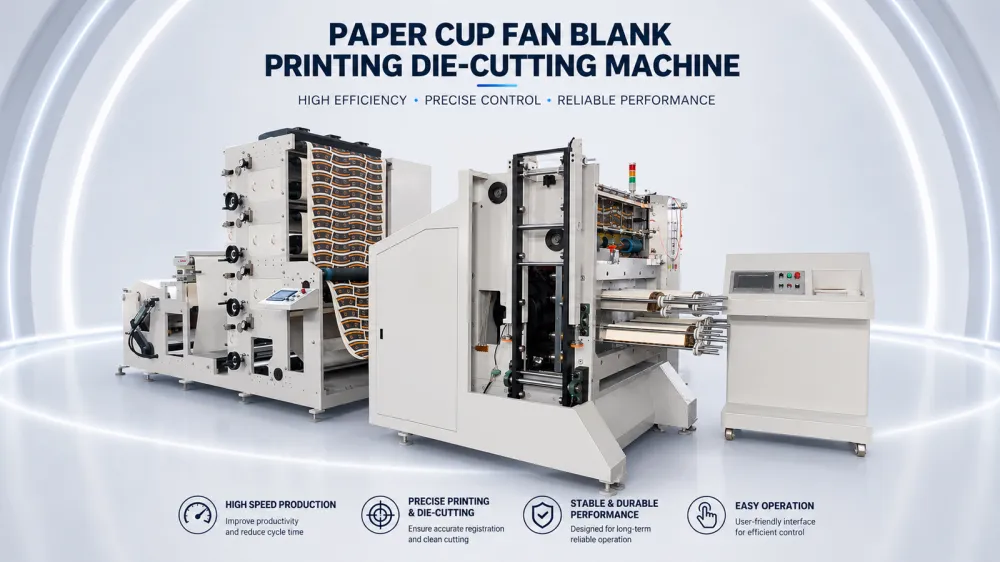
For example, buyers producing paper cups can review a dedicated paper cup printing machine to understand how the application affects machine configuration.
Define the product first, then the press architecture, and finally the manufacturer. This prevents buyers from comparing suppliers that are designed for completely different production requirements.
1. BOBST
BOBST serves industrial packaging printing and converting markets. It is most relevant to established flexible-packaging converters evaluating high-capacity production, automation and integrated packaging workflows.
Buyer fit: Large converters should compare application compatibility, stable production performance, automation, service and total investment—not maximum speed alone.
2. Windmöller & Hölscher
Windmöller & Hölscher (W&H) is strongly associated with industrial flexible-packaging production. Its solutions are relevant to high-volume converters where automation, process stability and plant-level productivity are important.
Buyer fit: Best evaluated for demanding film and flexible-packaging production where machine utilization can justify a high-performance industrial platform.
3. Mark Andy
Mark Andy focuses strongly on narrow-web label and packaging production. It is relevant to label converters managing multiple substrates, job lengths and inline finishing requirements.
Buyer fit: Compare printing and finishing as one workflow, especially when die cutting, embellishment and frequent job changes affect productivity.
4. Comexi
Comexi serves the flexible-packaging printing and converting market. It is particularly relevant when flexographic printing needs to operate efficiently alongside laminating, slitting and other downstream processes.
Buyer fit: Flexible-packaging converters should evaluate the complete production workflow rather than the printing press in isolation.
5. Uteco
Uteco supplies printing and converting technologies for flexible-packaging applications. Buyers should match the selected platform to their actual substrate structures, print widths, ink systems and production requirements.
Buyer fit: Medium and large packaging converters looking for industrial flexographic production.
6. Nilpeter
Nilpeter focuses on narrow-web label and specialty printing. It is relevant to converters producing pressure-sensitive, premium and other labels where print quality, flexibility and finishing are important.
Buyer fit: Label converters should compare substrate range, job mix, finishing requirements and changeover efficiency.
7. Edale
Edale serves label and paperboard packaging applications. Its equipment is particularly relevant where flexographic printing is combined with product-specific converting.
Buyer fit: Buyers producing labels, cartons or specialty products should evaluate the machine around the finished product and required converting sequence.
8. Gallus
Gallus is associated with narrow-web label production and integrated label workflows. It is relevant to established converters comparing flexographic, digital and combined production strategies.
Buyer fit: Evaluate the economics of real label jobs—including setup, waste, finishing and run length—rather than rated speed alone.
9. ZONBON Machinery
ZONBON Machinery is a China-based supplier of configurable flexographic printing and converting equipment. It can be considered by international buyers looking for machinery configured around specific materials, products and production requirements.
Buyer fit: Buyers comparing Chinese machinery suppliers should verify the exact configuration, application capability, testing conditions and after-sales scope rather than comparing quotation totals alone.
10. Henghao Machinery
Wenzhou Henghao Machinery Co., Ltd. manufactures Stack and Inline flexographic printing machines for labels, paper products and other roll-fed applications. Machine configuration can be adapted around the substrate, printing width, colors, drying and required converting process.
This approach is particularly relevant to distributors and international buyers who may initially have only a finished-product sample or basic customer requirement.
For entry-level label and paper applications, buyers can also review this 4-color Stack type flexo printing machine as a practical reference before discussing a customized configuration.
Buyer fit: Distributors, converters and manufacturers that need a configurable machine based on a defined product rather than a fixed standard specification.
How to Compare Flexo Printing Machine Manufacturers
Send the same production requirement to every shortlisted manufacturer. Otherwise, one supplier may quote a basic press while another includes more automation, tooling or converting functions, making the prices impossible to compare fairly.
| Compare | What to Check |
|---|---|
| Application fit | Finished product, substrate and relevant production experience |
| Machine specification | Width, colors, repeat, tension, registration and drying |
| Real productivity | Stable speed, setup time, changeover and waste |
| Converting | Die cutting, slitting, laminating, sheeting or other required processes |
| Quotation scope | Tooling, anilox rolls, cylinders, accessories and optional equipment |
| Testing | Sample trial and agreed factory acceptance conditions where required |
| Service | Installation, training, warranty, troubleshooting and spare parts |
| Ownership cost | Purchase price plus waste, labor, energy, maintenance and downtime |
The lowest quotation is not automatically the lowest-cost machine. First normalize the technical scope, then compare investment and expected operating cost.
What Information Should You Send in a Flexo Machine RFQ?
A useful RFQ does not need to be complicated. Provide the information that directly affects machine configuration:
- Finished product: label, flexible packaging, paper cup, paper bag or another product
- Material: substrate structure, thickness or GSM
- Width: material width and required printing width
- Printing: number of colors, artwork and repeat range
- Production: typical order size and expected output
- Converting: die cutting, slitting, sheeting, laminating or other processes
- Sample: finished product, substrate or artwork when available
If you are a distributor and the customer cannot provide a machine specification, start with the finished product. A sample or clear product photo can help the manufacturer identify the remaining technical questions.
Verify the Supplier Before You Order
For a high-value or customized press, verify the supplier before the final payment or purchase decision. Depending on project value and risk, this may include a factory visit, live video inspection, sample trial or Factory Acceptance Test (FAT).
- Confirm who manufactures and assembles the machine.
- Check machines currently under production where possible.
- Verify similar applications or representative printed samples.
- Confirm what is included in the final technical specification.
- Agree on critical acceptance criteria before shipment.
- Confirm installation, training, warranty and spare-parts responsibilities.
The objective is not to find a supplier with the longest feature list, but to verify that the proposed machine can meet the agreed production requirement.
Which Manufacturer Type Fits Different Buyers?
| Buyer | Manufacturer Direction | Priority |
|---|---|---|
| Large flexible-packaging converter | Industrial CI / wide-web specialist | Output, automation, waste and uptime |
| Label converter | Narrow-web / Inline specialist | Changeover, finishing and job economics |
| Paper-product manufacturer | Suitable Stack / Inline supplier | Material, width, colors, drying and converting |
| Distributor / agent | Configurable supplier with technical support | Application engineering, customization and service |
| First-time buyer | Supplier matched to actual production scale | Ease of operation, training and necessary functions |
Flexo Printing Machine Manufacturer FAQ
Should I Buy Directly From a Manufacturer or Through a Distributor?
Both models can work. Direct purchasing can simplify factory communication, while a capable distributor may provide local language, installation or service support. Confirm who is responsible for technical approval, warranty and after-sales service before ordering.
Can One Flexo Printing Machine Print Both Paper and Film?
Possibly, but compatibility must be checked against the actual materials. Paper and film can require different tension, drying, ink and surface-treatment conditions, so do not assume one configuration is suitable for every substrate.
Should I Buy More Printing Colors for Future Orders?
Only when future demand is realistic. Additional stations increase investment and machine complexity. Review current artwork and credible future jobs before deciding the number of colors.
Can a Manufacturer Recommend a Machine From Only a Product Photo?
A photo can start the discussion but normally cannot finalize the machine. The manufacturer will still need material, dimensions, colors, output and converting requirements. A physical sample or artwork is even more useful when available.
Is the Highest-Speed Flexo Press Always the Better Choice?
No. Real productivity also depends on stable operating speed, job changeovers, setup waste, material behavior and saleable yield. Choose capacity around actual production rather than maximum rated speed alone.
Should I Choose a Standard or Customized Flexo Printing Machine?
A standard configuration is usually simpler when it already matches the application. Customization is useful when a defined material, width, converting process or finished product requires it. Avoid adding options without a clear production benefit.
Need Help Matching a Flexo Press to Your Product?
If your project requires a Stack or Inline flexographic printing machine, you do not need to select the exact model before contacting Henghao.
Send the information you already have:
- Finished product or product photo
- Material and thickness / GSM
- Material and printing width
- Number of colors
- Artwork or sample if available
- Expected production volume
- Required die cutting, slitting, sheeting or other converting processes
The machine configuration can then be evaluated around the actual product instead of selecting equipment from a generic specification alone.
Conclusion
The manufacturers in this guide serve different parts of the flexographic printing market. The right choice depends on what you print, what material you use, how much you produce and what converting processes are required.
Start with the finished product, identify the appropriate press architecture, shortlist manufacturers with relevant application capability, and compare equivalent technical proposals before making the final investment decision.
For labels, paper cups and other configurable roll-fed applications, Henghao can evaluate the machine requirement from your product sample, material, width, colors and production target.
Share this article: