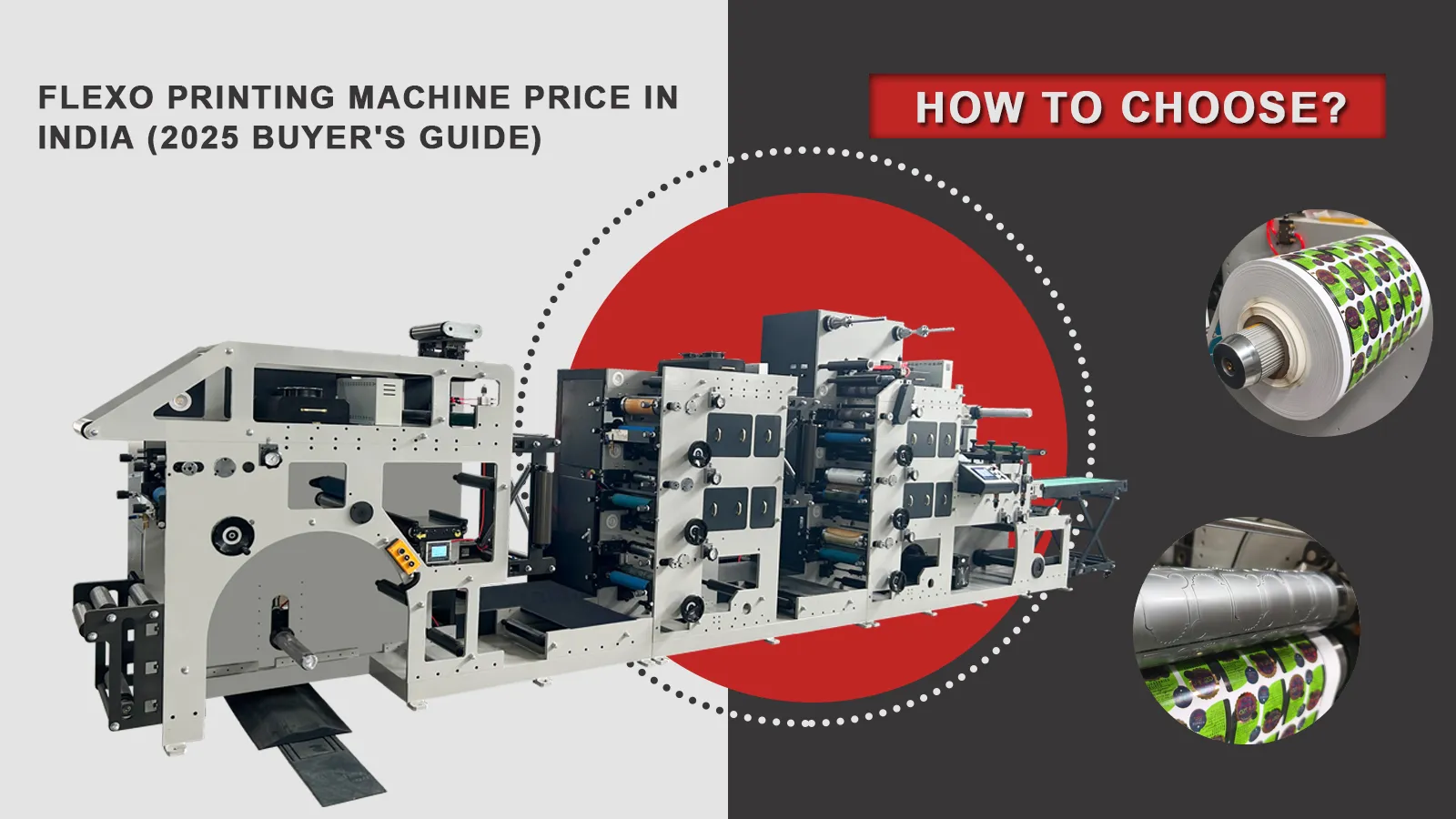
Flexo Printing Machine Price in India (2025 Buyer's Guide)
Introduction: Your Opportunity in India’s Booming Packaging Market
India's packaging industry is experiencing explosive growth, projected to climb from USD 101.12 billion in 2025 to USD 169.73 billion by 2030, a staggering 10.73% CAGR. This growth is driven by a rising middle class, increased urbanisation, and a massive e-commerce boom. The flexible packaging segment is leading this charge, holding over 54% of the market and growing at 11.51% annually. At the core of this success is flexographic printing. Flexo technology is essential for its speed, versatility across materials like plastic, foil, and paper, and cost-effectiveness for the print runs that define the packaging sector. For any business aiming to succeed in this market, investing in a flexo printing machine is a critical strategic move. This guide is designed to simplify your investment decision. We will break down the factors that determine the flexo printing machine price in India, helping you choose the right machine to build a long-term, profitable enterprise.
Section 1: Choosing the Right Flexo Press: CI vs. Inline vs. Stack
Before asking about price, you must decide on the right technology for your business. The press architecture you choose will define your initial cost, efficiency, print quality, and the markets you can serve.
1.1 Press Configurations: A Quick Comparison
Flexo presses come in three main designs: Central Impression (CI), Inline, and Stack. Each has unique strengths for specific production needs.
Central Impression (CI) Flexo Press
- How it Works: All print stations are arranged around a single, large impression cylinder. This holds the material securely, providing excellent stability.
- Strengths: Delivers superior registration accuracy and print quality, especially on thin and stretchy films used in high-quality food packaging. It minimises material stretch, allowing for precise colour alignment at high speeds (300-600 m/min).
- Best for India: Ideal for businesses supplying to large FMCG companies and exporters who require premium packaging like multi-layered food pouches and high-end labels.
Inline Flexo Press
- How it Works: Print units are arranged horizontally in a straight line, each with its own impression cylinder.
- Strengths: Highly modular and customisable. It's easy to add value-adding processes like lamination, die-cutting, and slitting in a single pass, making it a versatile all-in-one system. It performs excellently for labels and folding cartons.
- Best for India: The workhorse for the self-adhesive label market (pharma, FMCG, beverages) and for producing paperboard cartons and mid-web flexible packaging.
Stack Flexo Press
- How it Works: The simplest design, with colour stations stacked vertically.
- Strengths: Has a compact footprint, is simpler to operate and maintain, and comes with a much lower initial investment cost. It can also easily print on both sides of the material in one pass.
- Best for India: A perfect entry-point machine for high-volume, price-sensitive markets like paper shopping bags, milk pouches, and industrial woven sacks.
1.2 Key Technical Specifications to Know
- Web Width: The maximum width of the material roll the press can handle. It's categorised as Narrow-web (<500mm), Mid-web (500mm-1000mm), and Wide-web (>1000mm).
- Print Repeat: The maximum length of the printed image, which determines the size of bags, pouches, or labels you can produce.
- Ancillary Units: Optional modules for processes like lamination, die-cutting, and slitting. They add significant value and capability but also increase the initial price.
Table 1: Comparative Analysis of Flexo Press Architectures
| Feature | Central Impression (CI) | Inline | Stack |
| Print Quality & Registration | Excellent/Superior | Very Good | Good/Standard |
| Substrate Versatility | Best for thin, extensible films (e.g., LDPE, PET) | Excellent for labels, paperboard, thicker films | Good for paper, non-woven, HDPE/PP woven sacks |
| Maximum Speed | Very High (300-600 m/min) | High (100-200 m/min) | Moderate (80-150 m/min) |
| Footprint | Compact (Vertical) | Long (Horizontal) | Very Compact (Vertical) |
| Modularity/Upgradability | Low | High | Moderate |
| Typical Price Segment | ₹₹₹ (Premium) | ₹₹ (Mid-to-Premium) | ₹ (Entry-Level) |
| Ideal Indian Applications | Premium food packaging, export-quality flexible packaging, high-end shrink sleeves | Self-adhesive labels, folding cartons, paper cups, mid-web flexible packaging | Paper bags, milk pouches, woven sacks, basic industrial packaging |
Section 2: What Determines the Price of a Flexo Machine in India?
The price of a flexo machine is not a single number but a sum of its technical features. Understanding these cost drivers is key to negotiating effectively and choosing a machine that fits your budget and production needs.
2.1 Core Cost Drivers
- Number of Colour Stations: This is a primary cost driver. A basic 2- or 4-colour machine is far cheaper than an 8- or 10-colour press. Each extra colour requires a full print deck, increasing the machine's complexity and price. An 8-colour setup is often standard for high-quality graphics and advanced techniques like Extended Colour Gamut (ECG) printing.
- Printing Width & Speed: A wider machine requires larger, more robust components, increasing cost. Higher speeds (e.g., 200 m/min vs. 80 m/min) demand superior engineering, advanced tension control, and more powerful drying systems, all of which are premium features.
-
Automation & Control Systems: This is the biggest difference between entry-level and high-performance machines.
- Automatic Registration: Uses cameras and motors to align colours perfectly, drastically reducing setup time and waste compared to manual systems. This feature adds significant cost but boosts efficiency.
- Automatic Tension Control: Essential for maintaining print quality on thin films at high speeds. Basic machines use mechanical brakes, while high-end presses have advanced, closed-loop systems.
- Other Automation: Features like motorised print stations, web break sensors, and video inspection systems add to the price but improve productivity.
-
Drying & Curing Technology: The system used to dry ink affects speed, quality, and cost.
- Hot Air / Infrared (IR): The standard, lower-cost option for solvent- and water-based inks.
- Ultraviolet (UV) / LED-UV: Required for UV inks. UV curing is instant, allowing for higher speeds and a more durable finish. It is more expensive to install but essential for many premium applications.
2.2 The Indian Price Spectrum: Realistic Price Ranges
Online listings on platforms like IndiaMART show a vast price range, from ₹1.8 Lakh for a basic 4-colour machine to over ₹9 Crore for a high-end 8-colour press. This variance is due to the factors above. A cheap machine is likely a manual, slow, narrow-web stack press, while a multi-crore machine is a fully automated, wide-web CI press.
Table 2: Indicative Price Matrix for New Flexo Presses in India (INR)
| Number of Colours | Narrow-Web Inline (Labels, Sleeves) | Mid-Web Stack (Bags, Sacks) | Mid-Web Inline/CI (Flexible Packaging) | Wide-Web CI (High-Volume Film) |
| 2-4 Colour | ₹40 Lakh – ₹1 Crore | ₹15 Lakh – ₹50 Lakh | ₹90 Lakh – ₹1.5 Crore | N/A |
| 6 Colour | ₹80 Lakh – ₹1.5 Crore | ₹40 Lakh – ₹90 Lakh | ₹1.5 Crore – ₹4 Crore | ₹4 Crore – ₹7 Crore |
| 8+ Colour | ₹1.2 Crore – ₹2.5 Crore+ | ₹70 Lakh – ₹1.2 Crore+ | ₹2.5 Crore – ₹6 Crore+ | ₹6 Crore – ₹10 Crore+ |
Disclaimer: These prices are indicative and for base models. Final costs will vary based on manufacturer, level of automation, ancillary units, import duties, and taxes (GST).
A key takeaway is the trade-off between Capital Expenditure (CAPEX) and Operational Expenditure (OPEX). A low-priced machine (low CAPEX) usually has minimal automation, leading to higher running costs (high OPEX) from waste and reliance on skilled operators. A more expensive, automated machine (high CAPEX) can significantly lower the per-unit production cost, reducing OPEX and improving long-term profitability.
Section 3: Top Flexo Machine Suppliers in India: Domestic & International
Choosing a supplier is a long-term partnership that impacts reliability, service, and the overall success of your investment. The Indian market offers both strong domestic players and global technology leaders.
3.1 Domestic Champions: The "Make in India" Advantage
Indian manufacturers often provide a great balance of cost, local service, and an understanding of the domestic market.
- Mohindra Engineering Company: A Delhi-based manufacturer offering a wide range of Stack and CI presses known as reliable workhorses for various materials.
- NBG Printographic Machinery: An ISO-certified company with a reputation for precision, offering a full range of presses with a strong focus on the narrow-web label market.
- Star Flex International: A New Delhi-based manufacturer known for competitively priced machines for poly bags, woven sacks, and non-woven applications.
- Ishan International: An Ahmedabad-based global player offering a full range of machines with advanced feature options.
- Fairprint: Focuses on affordable, multi-colour machines for entry-level applications like non-woven and paper bags.
"It is worth noting that some brands operating in the Indian market do not manufacture their flexographic printing machines in-house. Instead, their equipment is often sourced from overseas factories—primarily in China—and rebranded for local distribution. While such arrangements are common, they may lead to inconsistencies in machine configuration, limited scope for customization, and challenges in after-sales service. Therefore, it is highly recommended that potential buyers conduct a thorough factory audit or on-site inspection before finalising any purchase. Visiting the actual manufacturing facility helps ensure transparency, assess build quality, and verify the supplier’s technical capabilities."
3.2 International Powerhouses: The Technology Leaders
Global leaders offer cutting-edge technology and automation at a premium price, ideal for meeting the highest quality standards.
- Henghao Machinery: A rising Chinese manufacturer offering cost-effective flexographic printing solutions with customizable configurations. Known for its growing export presence and ability to meet diverse production needs with reliable technology.
- UFlex: India's largest flexible packaging company and a global player, producing high-end CI flexo presses like the 'Elisa' model for the most demanding applications.
- BOBST: A Swiss giant known for high-performance CI flexo presses with industry-leading automation like smartGPS to reduce waste and setup time.
- Mark Andy: A US-based leader in the narrow-web label press market, whose machines are a benchmark for productivity and a top choice for Indian label converters.
- Nilpeter: A Danish innovator with a strong Indian presence, known for modular platforms and pioneering digital-flexo hybrid presses.
3.3 New vs. Used Equipment: A Critical Decision
Buying a used machine can lower your initial investment but comes with risks. While platforms like IndiaMART list used presses from ₹20,000 to ₹40 Lakh, these machines often lack warranties, have higher maintenance needs, and are less efficient than modern presses, potentially leading to a higher Total Cost of Ownership (TCO). A certified, pre-owned machine from a reputable OEM can be a good compromise, but buying an unverified used press is a significant gamble.
Table 3: Overview of Key Flexo Press Suppliers in India
| Manufacturer | Origin | Primary Machine Types Offered | Key Strengths / Specialisation | Target Market Segment |
| Mohindra Engineering | Domestic (India) | Stack, CI | Wide range, cost-effective, versatile for various substrates | Entry-Level to Mid-Market |
| NBG Printographic | Domestic (India) | Narrow-Web, Stack, Inline | ISO certified, precision engineering, strong in label presses | Mid-Market |
| Star Flex International | Domestic (India) | Stack, Inline | Highly competitive pricing, focus on bag/sack applications | Entry-Level |
| UFlex | Domestic (India) | High-Speed CI, Rotogravure | High-end technology, integrated packaging solutions provider | Premium / Global |
| BOBST | International (Swiss) | High-Speed CI, Inline | Cutting-edge automation, high efficiency, low waste | Premium / Global |
| Mark Andy | International (USA) | Narrow-Web Inline, Digital Hybrid | Global leader in label presses, strong service network | Premium (Labels) |
| Nilpeter | International (Danish) | Narrow-Web Inline, Digital Hybrid | Modular platforms, innovation in hybrid technology | Premium (Labels) |
Section 4: Beyond the Price Tag: Understanding Total Cost of Ownership (TCO)
The most important financial metric for a capital asset is not the purchase price, but the Total Cost of Ownership (TCO). The invoice price is just the beginning; the true cost includes all operational and maintenance expenses over the machine's life. A low initial price can be a "false economy" if the machine is inefficient and unreliable to run.
4.1 The TCO Formula
TCO = Initial Purchase Price (CAPEX) + Lifetime Operational Costs (OPEX) + Lifetime Maintenance Costs - End-of-Life Salvage Value
4.2 Key Operational Expenditures (OpEx)
-
Consumables: This is a major recurring expense.
- Printing Plates: Digital photopolymer plates can cost ₹1.10 to ₹1.40 per square centimetre, a significant cost for each new job.
- Inks: The choice between water-based, solvent-based, and UV inks impacts cost, performance, and compliance.
- Anilox Rollers & Doctor Blades: These precision parts wear out and require costly cleaning and replacement.
-
Running Costs:
- Power Consumption: An 8-colour press can consume 24 kW or more, making energy efficiency a major factor in long-term costs.
- Labour: A manual press may need two or three skilled operators, while a highly automated press might only need one, drastically reducing labour costs. This is critical given the shortage of skilled operators.
- Factory Floor Space: The machine's footprint has a real estate cost, especially in prime industrial areas.
-
Maintenance & Spares:
- Annual Maintenance Contracts (AMCs): An essential fixed cost for high-value presses.
- Spare Parts & Downtime: The availability of spares is vital. Every hour of downtime is lost revenue. Reliable machines maximise uptime and profitability.
4.3 A Practical TCO Framework
Use a worksheet to compare the potential 5-year TCO of different machines. This makes the financial impact of features like automation and speed clear.
Table 4: Sample 5-Year TCO Calculation Worksheet
| Cost Item (Annual unless specified) | Machine A (Lower CAPEX Example) | Machine B (Higher CAPEX Example) | Your Calculation |
| 1. Initial Investment (CAPEX) | |||
| Purchase Price | ₹ 90,00,000 | ₹ 2,50,00,000 | |
| Installation & Commissioning | ₹ 2,00,000 | ₹ 5,00,000 | |
| Total CAPEX | ₹ 92,00,000 | ₹ 2,55,00,000 | |
| 2. Annual Operational Costs (OPEX) | |||
| Material Waste (Setup & Running) | ₹ 15,00,000 | ₹ 5,00,000 | |
| Ink Waste (Setup & Cleaning) | ₹ 4,00,000 | ₹ 1,50,000 | |
| Energy Consumption | ₹ 8,00,000 | ₹ 6,00,000 | |
| Labour Cost (Operators) | ₹ 18,00,000 | ₹ 9,00,000 | |
| Plate Costs | ₹ 20,00,000 | ₹ 20,00,000 | |
| Annual OPEX Subtotal | ₹ 65,00,000 | ₹ 41,50,000 | |
| 3. Annual Maintenance Costs | |||
| AMC / Spares / Service Calls | ₹ 3,00,000 | ₹ 7,00,000 | |
| Total Annual Recurring Cost | ₹ 68,00,000 | ₹ 48,50,000 | |
| 4. 5-Year TCO Calculation | |||
| Total CAPEX | ₹ 92,00,000 | ₹ 2,55,00,000 | |
| Total 5-Year Recurring Costs | ₹ 3,40,00,000 | ₹ 2,42,50,000 | |
| Total 5-Year Cost of Ownership | ₹ 4,32,00,000 | ₹ 4,97,50,000 | |
Note: This is an illustrative example. Actual figures for waste, labour, and energy will vary based on specific machine performance and local costs. The purpose is to demonstrate the calculation methodology.
Section 5: Future-Proofing Your Investment: Key Trends
A flexo press is a long-term asset. To ensure its value, consider the key trends shaping the industry's future.
5.1 The Hybrid Revolution: Flexo + Digital
The future is not "Flexo vs. Digital," but "Flexo AND Digital." Hybrid presses combine the high-speed efficiency of flexo with the flexibility of digital for short runs and personalisation. This market is growing at a 12% CAGR globally and is already being adopted by leading Indian converters.
Investment Implication: Prioritise machines built on a modular platform. This allows you to start with a conventional flexo press and add a digital unit later, future-proofing your investment.
5.2 The Sustainability Mandate
Sustainability is now a core business driver in India, pushed by government regulations like Extended Producer Responsibility (EPR) and consumer demand for eco-friendly packaging.
Investment Implication: Your press must be part of your sustainability strategy. It should be compatible with water-based inks and engineered for energy efficiency and minimal waste. Features that reduce waste are no longer just cost-savers; they are environmental credentials.
5.3 Automation and 'Smart' Presses
The industry faces a shortage of skilled press operators. This "skill gap" is a direct threat to productivity and quality.
Investment Implication: Advanced automation is the solution. Technologies like automated colour control and registration reduce the need for highly skilled operators, ensuring consistent, repeatable quality. A "smart" press makes your operation more resilient and less dependent on a few key employees.
Section 6: Your Buying Guide: Checklist & Recommendations
This final section provides an actionable framework to guide your purchase.
6.1 Your Pre-Purchase Strategic Checklist
- Assess Your Core Needs: What products will you print (labels, pouches, bags)? On what materials (paper, film)? At what volume?
- Define Your Quality Standards: Are you serving local, cost-focused clients or national brands with strict quality mandates? This determines if a basic stack press is enough or if a high-precision CI press is required.
- Establish Your TCO Budget: Plan for the Total Cost of Ownership, not just the initial price. Model the 5-year costs to see what you can afford to run profitably.
- Shortlist Suppliers: Based on your needs and budget, create a shortlist of 3-5 domestic and international suppliers.
-
Conduct Due Diligence:
- Get Live Demos: Insist on seeing the machine run with your own materials and artwork.
- Verify Performance: Challenge the claimed speeds and ask for realistic production speeds for your jobs.
- Talk to Existing Customers: Get references and speak to current users about the machine's real-world performance and reliability.
- Confirm After-Sales Support: Check service team locations, spare part availability in India, and AMC terms.
6.2 Final Recommendations
- For Entry-Level, Commodity Applications (e.g., paper bags, sacks): A robust Stack Press or basic Inline Press from a reputable Indian manufacturer offers the best value.
- For High-Quality Labels & Cartons (e.g., for FMCG, pharma): A well-automated Inline Press from a top domestic or international supplier is the ideal choice for its versatility and precision.
- For Premium Flexible Packaging (e.g., for food, exports): A high-speed Central Impression (CI) Press from a global leader or a top-tier Indian firm like UFlex is a necessary investment to meet the highest quality standards.
In all cases, investing in automation, energy efficiency, and sustainability is an investment in the future profitability and resilience of your business.
Call to Action: Ready to Take the Next Step? Get a Customised Quote for Your Production Needs
You now possess the strategic framework to make a well-informed investment decision. However, the optimal configuration for a flexo printing press is unique to each business. To translate this knowledge into a concrete proposal, the next step is to obtain precise, customised quotes based on your specific production requirements.
To receive a detailed quotation tailored to your needs—including web width, colour stations, desired automation level, and finishing options—contact our experts today. We will help you articulate your requirements, connect you with the most suitable suppliers, and assist in analysing their proposals to ensure you secure the best possible return on your investment.
Share this article: