A Guide to the Flexographic Printing Process
Flexographic printing, or "flexo", is a high-speed, rotary printing process that stands as a cornerstone of the global packaging and label industries. Using flexible printing plates and fast-drying inks, it can print on nearly any material, including plastic films, paper, corrugated cardboard, and metallic foils. Its combination of speed, versatility, and cost-effectiveness for medium-to-long production runs makes it an indispensable technology for creating everything from food packaging and self-adhesive labels to shipping boxes and newspapers.
This guide provides a clear, step-by-step overview of the modern flexographic workflow, from raw material to finished product.
To illustrate the process, here is a typical workflow for a multi-color print job:
Roll of Substrate (e.g., Paper, Film, Label Stock) → Unwinding & Tension Control → Web Guiding (EPC) → Surface Treatment (if required) → Sequential Printing & Drying (Color 1, 2, 3, 4...) → Cooling → In-line Finishing (e.g., Die-Cutting, Slitting) → Rewinding into Finished Rolls
Recommended Flexo Printing Machines:
-
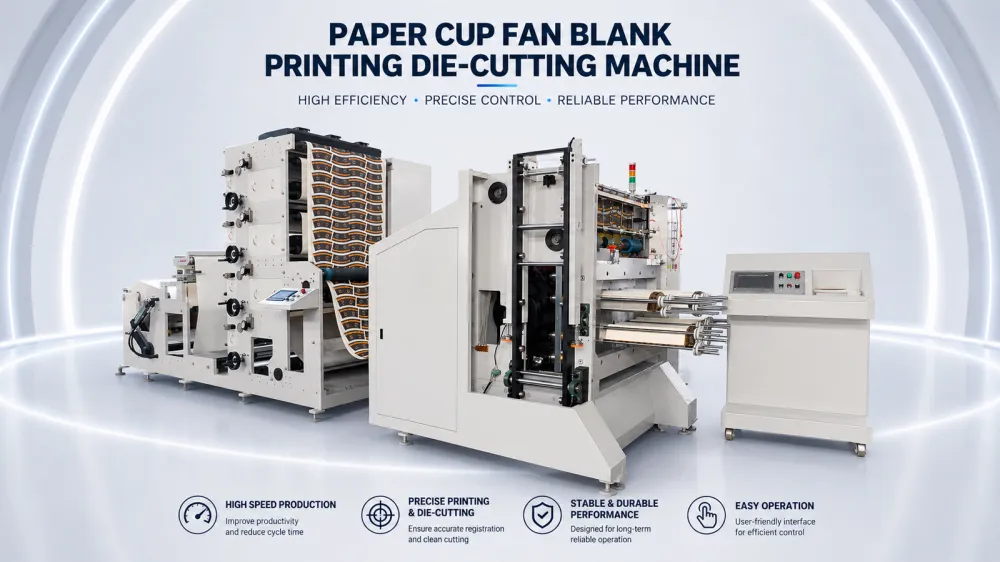
Paper Cup Printing Machine
Designed specifically for paper cup manufacturers, this machine delivers precise and vibrant flexographic printing on single or double PE coated paper. Ideal for high-speed, food-safe production environments.
-
Paper Wristband Printing Machine
Specially engineered for printing on synthetic and waterproof materials, this machine is perfect for producing event wristbands, hospital ID bands, and more. High-resolution flexo printing ensures clarity and durability.
-
UV Flexo Printing Machine
A versatile solution for printing on a wide range of substrates—paper, film, labels—using UV-curable inks. Offers instant drying, sharp color reproduction, and excellent print adhesion.
-
9 Colors Flexo Label Printing Machine
Built for complex, high-value label production. This multi-color flexo printer ensures tight registration, vibrant colors, and efficiency, making it ideal for cosmetics, beverages, and industrial labels.
-
Custom Built Flexo Printing Machine
Tailored to your production needs. Options include inline die cutting, slitting, corona treatment, and dual rewinding systems. Perfect for converters who need full control and flexibility in one machine.

The following sections will explore each of these critical stages in detail.
Step 1: Web Handling and Preparation
Before any ink is applied, the raw material—a large roll of substrate known as the "web"—must be perfectly prepared for the high-speed printing process. This stage is a proactive quality control system designed to ensure stability and consistency.
- Unwinding and Tension Control: The process begins at the unwind unit, where the master roll is loaded. From the moment it unwinds, the web is placed under precise tension. A tension control system, using either dancer rolls (a floating roller that absorbs fluctuations) or load cells (sensors that directly measure force), is critical. Proper tension is non-negotiable; too little causes wrinkles and misregistration, while too much can stretch the material or cause it to break.
- Web Guiding (EPC): As the web travels through the press, it can drift from side to side. An Edge Position Control (EPC) system uses sensors (optical or ultrasonic) to detect the web's edge and an actuator to make real-time corrections, ensuring the material enters each print station in the exact same lateral position. This precise alignment is essential for sharp, in-focus color printing.
- Corona Treatment (Optional): Non-porous substrates like plastic films are chemically inert and have low surface energy, meaning ink will not bond to them effectively. To solve this, an in-line corona treater bombards the material's surface with a high-voltage electrical discharge. This process cleans the surface and increases its surface energy (dyne level), making it chemically receptive to ink and ensuring strong, permanent adhesion.
Step 2: The Printing Station and Ink Transfer
The heart of the flexo press is the series of printing stations, where each station applies a single color. A typical four-color job (CMYK) uses four stations, but modern presses often have eight or more to accommodate additional brand colors and varnishes in a single pass. A common configuration for this type of machinery is the stack press. In a stack press, the printing stations are arranged vertically, one on top of another. This design has a smaller footprint and provides easy access to each station for maintenance and adjustments. A key advantage of the stack press is its ability to be configured to print on both sides of the web in a single pass.
The magic of flexo lies in its precision ink metering system, which relies on two key components:
- The Anilox Roller: Considered the "heart of the flexo process," the anilox is a ceramic-coated, laser-engraved cylinder. Its surface contains millions of microscopic cells that pick up ink and transfer a precise, uniform volume to the printing plate. The roller's specifications—line screen (cells per inch) and cell volume—determine the ink film thickness. High line screens with small cells are used for fine details and process images, while low line screens with large cells are used for solid color blocks and coatings.
- The Doctor Blade System: To ensure precision, a doctor blade scrapes excess ink from the anilox roller's surface, leaving ink only in the engraved cells. While simple open systems exist, modern high-speed presses use an enclosed chambered doctor blade system. This design uses two blades—a metering blade and a containment blade—to create a sealed ink chamber that prevents contamination and solvent evaporation, ensuring stable ink viscosity and a cleaner printing process.
Once inked, the flexible printing plate transfers the image to the substrate as it passes between the plate cylinder and an impression cylinder.
Step 3: Drying and Curing
After each color is applied, the ink must be fixed before the next station. This inter-station drying is crucial to prevent colors from smudging or mixing. There are two primary technologies for this:
- Evaporative Drying (Hot Air & IR): Used for water-based and solvent-based inks, this is a physical process. High-velocity hot air or Infrared (IR) lamps apply energy to evaporate the liquid carrier (water or solvent), leaving the solid pigments and resins behind.
- Radiation Curing (UV & LED-UV): Used for UV-curable inks, this is a photochemical process. The inks are 100% solids and contain photoinitiators. When exposed to intense ultraviolet light, these photoinitiators trigger a polymerization reaction that instantly hardens the liquid ink into a durable, solid film. LED-UV curing is the modern evolution of this technology, offering significant advantages: it consumes far less energy, produces no heat (making it ideal for thin films), has a much longer operational life, and is safer as it contains no mercury and generates no ozone.
Step 4: In-Line Finishing and Rewinding
One of flexography's greatest strengths is its ability to integrate finishing processes into a single pass, dramatically increasing efficiency.
- Cooling: After passing through dryers, the hot web is stabilized by chill rolls—internally cooled rollers that quickly reduce the web's temperature to prevent stretching and set the ink.
- Rotary Die-Cutting: For products like labels and cartons, a rotary die-cutting station uses a cylindrical die to cut custom shapes, create perforations, or score fold lines at high speed. A common technique is kiss-cutting, where the die cuts through the label face stock but only "kisses" the backing liner, leaving it intact for easy peeling.
- Slitting and Rewinding: Finally, the wide, printed web is cut into narrower strips by a slitting unit and then wound onto new cores at the rewind station, creating the finished rolls ready for shipment.
Conclusion: A Versatile and Evolving Technology
Flexography has evolved from a simple printing method into a sophisticated, high-tech manufacturing process. Its ability to print high-quality graphics at high speeds on an unparalleled range of materials ensures its continued dominance in the packaging and label industries. The integration of digital controls, advanced web handling, and innovative technologies like LED-UV curing allows flexography to meet the modern demands for efficiency, quality, and sustainability.
Share this article: