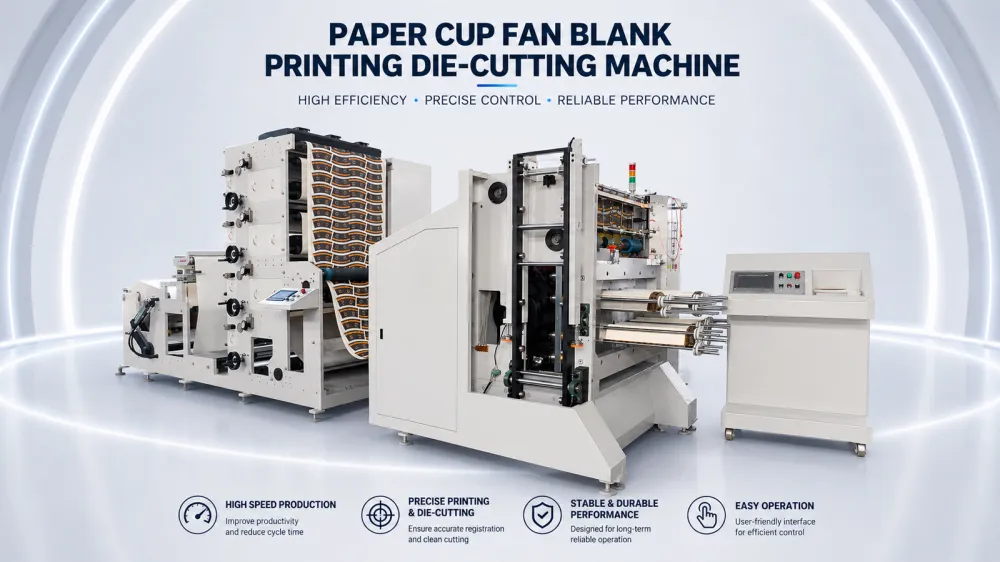
Electricity Costs in Printing: How Servo Motors Save You Money
If your factory is located in a high-energy-cost region like Brazil, Germany, or Italy, electricity is likely your second-highest operating cost after raw materials. In 2026, the gap between a "cheap" mechanical press and an energy-efficient servo press is measured in thousands of dollars per year.
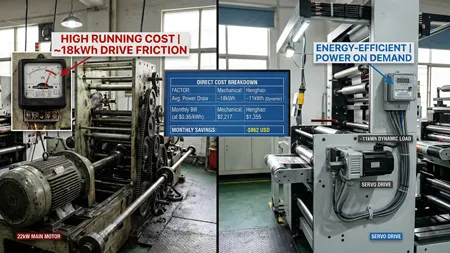
Traditional mechanical flexo machines rely on one massive main motor (often 22kW or higher) connected to a complex web of shafts, gears, and chains. Whether you are printing at 10m/min or 100m/min, that big motor is drawing heavy current to overcome mechanical friction.
1. Power on Demand: Why Servos are Smarter
A Henghao Full-Servo System replaces that one hungry motor with independent, high-efficiency servo drives at each station.
- No Idle Waste: Servo motors only draw the exact amount of torque needed for the current speed and tension. During setup or slow runs, power consumption drops drastically.
- Regenerative Braking: Modern servo drives can capture energy during deceleration and feed it back into the system—something a mechanical brake simply wastes as heat.
- Eliminating Friction: By removing meters of heavy drive shafts and dozens of gears, you eliminate the "mechanical drag" that forces old machines to work harder.
2. The Calculation: Real-World Savings
Let’s run the numbers for a standard 6-color label press operating 16 hours a day (2 shifts), 22 days a month.
| Factor | Mechanical Press (22kW Main) | Henghao Servo System |
|---|---|---|
| Avg. Power Draw | ~18 kWh | ~11 kWh (Dynamic) |
| Daily Consumption | 288 kWh | 176 kWh |
| Monthly Bill (at $0.35/kWh*) | $2,217 | $1,355 |
| Monthly Savings | - | $862 USD |
*Based on average industrial electricity rates in Europe/Brazil (2025-2026).
In this scenario, a Henghao Servo Press saves you over $10,000 USD per year on electricity alone. Over a 10-year lifespan, the machine literally pays for its own technology upgrade.
3. Higher Power Factor, Lower Penalties
In many regions, utility companies charge "Reactive Power Penalties" if your factory has a poor power factor (common with old, large induction motors). Servo drives act as active power factor correctors, keeping your factory's electrical efficiency high and avoiding these extra fines on your utility bill.
Decision Maker's FAQ
Q: "Is the servo system more sensitive to power fluctuations?"
A: We use industrial-grade voltage stabilizers and high-quality filters in our control cabinets. In regions like Brazil or Africa where the grid can be unstable, these protections are mandatory and included in our export-grade machines.
Q: "Does higher speed mean higher energy waste?"
A: Actually, the efficiency of a servo motor is highest at its optimal torque curve. Unlike mechanical gears that generate exponential friction heat as speed increases, servos remain efficient even at 150m/min.
Q: "How do I calculate the ROI for my specific local electricity rate?"
A: Simply take your current monthly bill and multiply the 'Machine Power' portion by 35%. That is the baseline of what you are currently wasting on mechanical friction and idle draw.
The Bottom Line
In 2026, energy efficiency is no longer a "green" choice; it's a competitive necessity. Every dollar you save on electricity is a dollar added directly to your net profit.
Stop bleeding cash into the grid.
Contact Henghao Machinery today. We can provide a detailed energy consumption forecast based on your specific local electricity rates and production schedule. Explore our energy-efficient servo flexo solutions now.
Share this article: