Die Cutting vs Laser Cutting: Material & Edge Quality
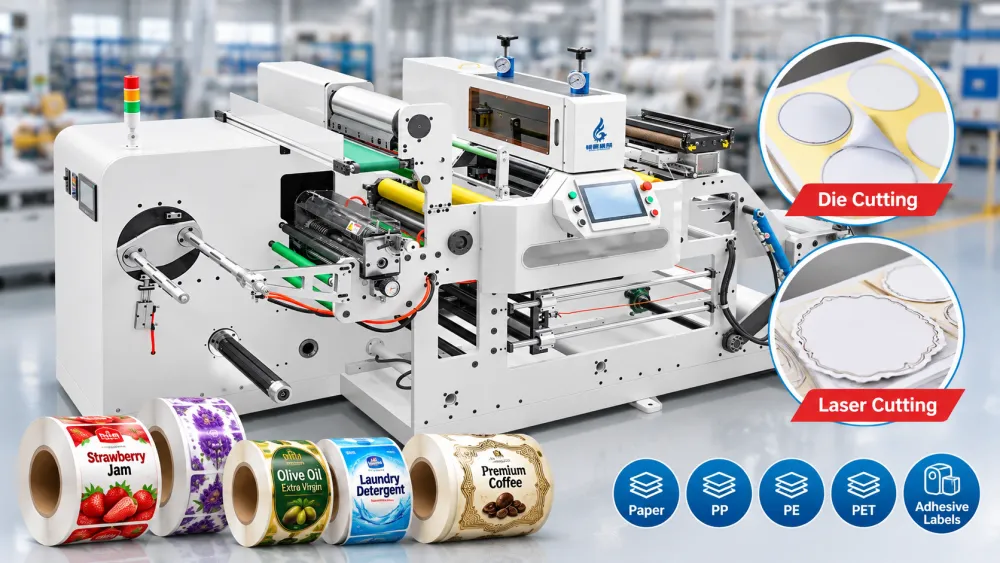
Mechanical die cutting and laser cutting can both produce custom label shapes, but their suitability depends on how the material responds to cutting force or heat. Mechanical die cutting uses a physical cutting tool, while laser cutting uses a focused laser beam to follow a programmed cutting path.
For label converters, the decision is not simply about cutting speed or tooling costs. Paper coatings, plastic film properties, adhesive layers and release liners can affect cut-edge quality, dimensional stability and the finished label.
This guide compares both processes by material type and explains what buyers should check before selecting a cutting method for paper, film and pressure-sensitive labels.
Die Cutting vs Laser Cutting: What's the Difference?
The main difference is the cutting mechanism. Mechanical die cutting uses a manufactured cutting die to separate material through controlled mechanical contact. Laser cutting uses concentrated energy to process material along a digitally defined path.
In this comparison, die cutting refers to conventional mechanical die cutting, including rotary and flatbed systems. Laser cutting refers to laser-based cutting of label materials, sometimes called laser die cutting in the converting industry.
Both methods may support kiss cutting or through cutting when the equipment and material construction are compatible. However, their effects on the material can differ significantly.
| Comparison Factor | Mechanical Die Cutting | Laser Cutting |
|---|---|---|
| Cutting mechanism | A physical die cuts the material through mechanical contact. | A focused laser beam processes the material along a programmed path. |
| Material interaction | Applies localized cutting force and pressure. | Introduces concentrated thermal energy into the cutting area. |
| Cutting tool | Requires a compatible physical cutting die. | Does not require a shape-specific mechanical die. |
| Typical material concerns | Compression, stretching, tearing and incomplete cutting. | Melting, discoloration, heat-affected edges and fumes. |
| Adhesive labels | Cutting engagement must protect the release liner. | Laser settings must account for the face stock, adhesive and liner. |
| Cut-edge quality | Depends on die condition, cutting force and material behavior. | Depends on material response, beam characteristics and processing settings. |
| Material suitability | Depends on tooling geometry, machine capability and material construction. | Depends on material composition, thermal response and equipment safety requirements. |
Neither method guarantees cleaner edges or higher accuracy for every material. The cutting result must be evaluated using the actual label construction and required finished quality.
Which Materials Are Suitable for Each Process?
Material compatibility should be evaluated using the complete label construction, not only the face-stock name. Two materials described as PP, PET or coated paper may behave differently because of their thickness, coatings, adhesives or surface treatments.
The following comparison highlights common material-related considerations for mechanical die cutting and laser cutting. It is a selection guide, not a universal approval list for laser processing.
| Label Material | Mechanical Die Cutting | Laser Cutting | What to Verify |
|---|---|---|---|
| Coated Paper | Commonly suitable with compatible tooling and cutting engagement. | May be suitable, but coatings and paper fibers can show thermal effects. | Edge discoloration, coating damage, fiber tearing and liner integrity. |
| PP / BOPP Film | Requires suitable die geometry, web control and cutting depth. | Heat may cause melting, shrinkage or edge deformation. | Edge shape, dimensional stability and adhesive response. |
| PE Film | Material flexibility and stretching can affect cutting consistency. | Thermal deformation and melting require careful evaluation. | Film distortion, cut dimensions and finished-edge condition. |
| PET Film | Tooling must accommodate material toughness and thickness. | Suitability depends on film formulation and laser processing conditions. | Edge appearance, thermal effects and complete separation. |
| Self-Adhesive Label Stock | Requires controlled cutting through the face stock and adhesive. | Adhesive and liner response must be assessed together with the face stock. | Adhesive residue, liner damage and label release. |
| Laminated or Multilayer Labels | Different layer properties may affect cutting-force requirements. | Layers may respond differently to heat, creating edge defects or separation. | Layer bonding, edge quality and material safety. |
Paper Labels: Check Coatings and Edge Appearance
Paper labels are commonly processed using mechanical dies. Cutting quality depends on die sharpness, paper structure, coatings and cutting engagement. Poorly matched tooling may cause fiber tearing, rough edges or damage to the release liner.
Laser cutting may also be feasible for compatible paper constructions. However, heat can cause visible discoloration, edge darkening or coating changes. The acceptable result depends on the label's appearance requirements and material formulation.
PP, BOPP and PE Films: Evaluate Heat and Stretching
Flexible polyolefin films require attention to dimensional stability. During mechanical die cutting, excessive web tension or unsuitable cutting conditions can contribute to stretching, distortion or inconsistent cut positions.
During laser cutting, thermal energy can cause melting, shrinkage or edge deformation. These effects depend on film composition, thickness, laser settings and the required cutting geometry.
For transparent or appearance-sensitive film labels, even small changes around the cut edge may be unacceptable. Sample testing should include visual inspection and dimensional measurements after cutting.
PET Films: Check Cutting Force and Thermal Response
PET labels may require suitable mechanical die geometry and cutting engagement because of their material strength and resistance to tearing. Inadequate tooling can cause incomplete separation or inconsistent edges.
Laser cutting performance depends on the PET formulation, thickness and processing conditions. The material should be tested for edge changes, discoloration and dimensional stability before approving the process.
Adhesive and Multilayer Labels: Test the Complete Construction
Pressure-sensitive labels contain more than a face material. Adhesives, release coatings and liners can respond differently to mechanical pressure or laser energy.
Mechanical cutting must achieve the required cutting depth without damaging layers that need to remain intact. Laser processing must also account for thermal effects on the adhesive and release liner.
For laminated constructions, different layers may require different cutting conditions. A process that cuts the top layer cleanly may still produce unacceptable results in the adhesive or supporting layers.
Important: Materials with unknown compositions should not be approved for laser cutting without confirming their chemical compatibility and the equipment manufacturer's safety requirements. Certain chlorine-containing materials and other formulations can release hazardous or corrosive decomposition products during laser processing.
How Does Heat Affect Laser-Cut Label Materials?
Laser cutting introduces concentrated thermal energy into the material, while mechanical die cutting separates material through physical cutting force. This difference matters when processing heat-sensitive films, coated papers and adhesive label constructions.
The amount of thermal damage depends on the material composition, laser wavelength, power, processing speed, beam characteristics and cutting path. A material that can be laser-cut successfully under one set of conditions may produce unacceptable edges under another.
Melting, Shrinkage and Edge Deformation
Thermoplastic films such as PP, BOPP and PE may soften, melt or shrink near the laser cutting path. Depending on the material and settings, this can create raised edges, dimensional changes or local distortion.
Mechanical die cutting avoids direct laser heating, but excessive cutting force, unsuitable tooling or unstable web tension can still deform flexible films. Buyers should compare finished cut dimensions and edge appearance rather than assuming either method is defect-free.
Discoloration and Coating Damage
Laser processing may cause darkening, discoloration or changes to surface coatings on certain paper and film constructions. These effects can be especially noticeable on white labels, transparent films and products with strict appearance requirements.
Mechanical cutting does not produce the same direct thermal effects, although dull dies or excessive cutting pressure may cause rough edges, coating cracks or unwanted impressions.
Adhesive Response and Thermal Residue
Pressure-sensitive adhesives can react to laser energy differently from the face stock. Local heating may change adhesive behavior, create residue or affect the separation of the finished label from its surrounding waste matrix.
A visually clean face-stock edge does not necessarily mean the adhesive layer has been processed correctly. Inspect the complete cut edge and confirm that labels can be dispensed or removed from the liner without unwanted sticking or adhesive transfer.
Laser Processing Safety and Material Restrictions
Material safety must be confirmed before laser cutting trials. Some materials can release hazardous or corrosive decomposition products when heated by a laser. Chlorine-containing materials, including certain PVC constructions, require particular caution and may be prohibited by the laser equipment manufacturer.
Buyers should obtain material composition information and relevant safety documentation, then confirm compatibility with the laser system and its extraction and filtration equipment. Unknown or unapproved materials should not be processed until these requirements are resolved.
Kiss Cutting and Release Liner Protection
Kiss cutting separates the label face stock and adhesive while leaving the release liner sufficiently intact for subsequent handling and dispensing. Both mechanical and suitable laser cutting systems may support this operation, but the methods of controlling cutting depth are different.
Mechanical Kiss Cutting
Mechanical kiss cutting relies on the relationship between the die, material thickness, cutting engagement and supporting surface. The cutting tool must separate the intended layers without cutting through or excessively marking the liner.
Tool wear, inconsistent material thickness or incorrect cutting engagement can cause incomplete cuts or liner damage. Regular sample inspection is important when changing label materials or adhesive constructions.
Laser Kiss Cutting
Laser kiss cutting uses controlled energy delivery to process selected layers of a label construction. The achievable depth depends on material absorption, layer thickness, laser settings and the equipment's process-control capability.
Unlike mechanical cutting, laser processing may affect adjacent layers through heat. A suitable cutting path must therefore be evaluated for both face-stock separation and potential damage to the adhesive or release liner.
How to Check Release Liner Integrity
A successful kiss cut should allow the label to separate cleanly while maintaining the liner's intended function. Visual inspection alone may not reveal all liner damage.
- Cut completion: Confirm that the label separates without tearing the face stock.
- Liner condition: Check for cuts, excessive scoring, weakening or thermal damage.
- Adhesive behavior: Inspect for adhesive stringing, residue or unwanted bonding.
- Matrix removal: Confirm that surrounding waste can be removed without lifting finished labels.
- Dispensing performance: Test label release and liner handling under representative downstream conditions.
The acceptable level of liner marking depends on the intended application and customer specification. For automatic labeling, the test should also confirm reliable dispensing at the required operating conditions.
Edge Quality and Common Cutting Defects
Cut-edge quality should be evaluated against the finished label's functional and visual requirements. Mechanical cutting defects are often related to tooling, cutting engagement and material movement, while laser cutting defects may involve thermal effects, material absorption and processing settings.
The table below identifies common symptoms and possible causes. It should be used as a troubleshooting reference rather than a substitute for material trials.
| Cutting Defect | Mechanical Die Cutting: Possible Causes | Laser Cutting: Possible Causes | What to Check |
|---|---|---|---|
| Rough or irregular edges | Dull die, unsuitable cutting engagement or material tearing. | Unstable processing conditions or material response along the cutting path. | Edge appearance under suitable magnification. |
| Melting or raised edges | Not normally caused by direct thermal cutting; mechanical deformation may occur. | Excessive local heating or unsuitable processing settings. | Edge profile, dimensional change and material distortion. |
| Discoloration or dark edges | May result from material marking or contamination rather than laser heating. | Thermal changes to the face stock, coating or printed surface. | Color consistency and visible edge marks. |
| Incomplete cutting | Insufficient engagement, worn tooling or uneven material thickness. | Insufficient effective energy or unsuitable material response. | Complete separation along the entire outline. |
| Liner damage | Excessive cutting engagement or unsuitable tooling setup. | Excessive penetration or thermal effects on the liner. | Liner strength, scoring and dispensing performance. |
| Adhesive residue or sticking | Adhesive stringing, compression or incomplete layer separation. | Adhesive heating, residue formation or layer interaction. | Label release, matrix stripping and adhesive transfer. |
| Dimensional inconsistency | Web tension, tooling alignment or material stretching. | Registration errors, material movement or thermal deformation. | Finished dimensions and cut-to-print registration. |
How Should Buyers Inspect Finished Cut Edges?
Inspection should cover more than whether the label outline looks correct. Buyers should check dimensional accuracy, edge appearance, adhesive separation and the condition of supporting layers.
For transparent or decorative labels, inspect the edges against a contrasting background. For printed labels, check cut-to-print registration. For pressure-sensitive labels, test matrix stripping and dispensing performance using representative finished rolls.
A cutting sample should be accepted only when both its appearance and downstream handling meet the agreed production requirements. A clean-looking edge is not sufficient if the liner is damaged, adhesive residue remains or labels cannot be dispensed reliably.
How to Test Material Compatibility Before Production
The most reliable way to compare mechanical die cutting and laser cutting is to test the actual material construction under representative production conditions. A successful trial should confirm not only that the material can be cut, but also that the finished labels meet quality, handling and safety requirements.
Before testing, provide the supplier with the complete material specification, cutting outline, finished-label requirements and intended production format.
Step 1: Prepare Representative Material Samples
Use the same face stock, coating, adhesive and release liner intended for production. Include the actual printed or laminated construction when these layers may influence cutting behavior.
For laser cutting, confirm material composition and processing safety before starting the trial. Materials that have not been approved for the laser system should not be tested.
Step 2: Test the Required Cutting Operations
Ask the supplier to demonstrate the operations required by the application, such as kiss cutting, through cutting or perforation. Use representative cutting shapes, including the smallest details and most demanding corners.
Record the machine configuration, material specifications and relevant processing settings so that the results can be compared and reproduced.
Step 3: Inspect Finished Labels and Downstream Handling
Inspect the samples for cutting accuracy, edge condition, adhesive behavior and release-liner integrity. Where applicable, test waste matrix removal, rewinding and automatic label dispensing.
A sample that looks acceptable immediately after cutting may still fail during matrix stripping, rewinding or dispensing. These downstream operations should be included in the acceptance process.
Material Cutting Trial Checklist
| Inspection Item | What to Check | Acceptance Basis |
|---|---|---|
| Material identification | Face stock, coating, adhesive, liner and material thickness | Matches the approved production specification |
| Cut dimensions | Finished outline, critical features and dimensional consistency | Within the agreed drawing tolerances |
| Cut-edge appearance | Tearing, roughness, melting, discoloration or deformation | Meets the agreed visual and functional requirements |
| Cut completion | Complete separation of the intended material layers | No unacceptable uncut sections or connected edges |
| Adhesive condition | Residue, stringing, transfer or unwanted sticking | Acceptable adhesive behavior during handling |
| Release liner | Scoring, penetration, weakening or thermal damage | Retains the required handling and dispensing performance |
| Waste removal | Matrix separation and unwanted label lifting | Stable removal under representative operating conditions |
| Laser safety | Approved material, extraction and filtration requirements | Complies with equipment and site safety requirements |
Buyers should agree on measurable acceptance criteria before the trial. The final record should include sample identification, test conditions, inspection results and any limitations identified during processing.
Which Cutting Process Should You Choose?
Choose the cutting process that can consistently meet the material's functional and quality requirements. Tooling flexibility and production efficiency matter, but they should not override material compatibility or safety.
| Production Requirement | Process to Evaluate | Selection Reason |
|---|---|---|
| Heat-sensitive plastic films | Mechanical die cutting | Avoids direct laser heating, subject to suitable mechanical tooling and material control |
| Paper labels requiring clean, consistent edges | Both processes | Compare mechanical edge quality with possible laser discoloration or coating effects |
| Pressure-sensitive labels with sensitive release liners | Both, subject to kiss-cut testing | Liner integrity and dispensing performance determine suitability |
| Frequent changes to complex cutting outlines | Laser cutting, if material-compatible | Programmable cutting paths can reduce the need for shape-specific dies |
| Stable repeat orders with existing tooling | Mechanical die cutting | Reusable dies may support efficient repeat production |
| Unknown or unapproved material composition | Do not proceed with laser cutting until verified | Material safety and equipment compatibility must be established first |
| Multilayer labels with different material responses | Both, subject to complete-construction testing | Each layer must remain functional after cutting |
When Is Mechanical Die Cutting a Practical Choice?
Mechanical die cutting is worth evaluating when the material is sensitive to heat, the label design is stable or compatible tooling is already available. Rotary and flatbed systems can support different label converting requirements, depending on machine configuration and material specifications.
Buyers considering conventional label converting equipment should evaluate the cutting format, tooling compatibility, web handling and downstream finishing requirements before selecting a machine.
When Is Laser Cutting Worth Evaluating?
Laser cutting may be useful when frequent outline changes make dedicated physical dies less convenient, provided that the complete material construction is approved for laser processing.
The absence of a shape-specific cutting die does not guarantee acceptable material quality. Buyers must still verify thermal effects, adhesive response, liner integrity, extraction requirements and actual production output.
What Should You Include in an Equipment RFQ?
For a meaningful quotation, provide the supplier with the material specification, cutting drawings, required tolerances, order quantities, finished-roll format and representative samples.
Ask the supplier to identify any material restrictions, required tooling or consumables, supported cutting operations and acceptance-test conditions. Compare equipment only after confirming that it can produce acceptable finished labels.
Die Cutting vs Laser Cutting FAQ
Can Laser Cutting Replace Mechanical Die Cutting for Every Label Material?
No. Some materials are unsuitable for laser processing because of thermal damage, hazardous emissions or equipment restrictions. Mechanical cutting may also face limitations related to material toughness, flexibility or tooling geometry.
Does Laser Cutting Always Produce More Accurate Labels?
No. Accuracy depends on machine capability, registration control, material stability and processing conditions. Both processes should be evaluated against the same dimensional and cut-to-print tolerances.
Can Printed Labels Be Laser-Cut Without Damaging the Ink?
Possibly, but this depends on the ink, coating, substrate and laser settings. Printed samples should be tested for discoloration, edge changes, residue and any effects on the finished appearance.
Is Laser Cutting Suitable for Transparent Film Labels?
Suitability depends on the film formulation and its interaction with the laser system. Transparent films may show edge deformation or other changes that are especially visible in the finished product. Material-specific trials are necessary.
Which Process Is Better for Automatic Label Dispensing?
Neither process is automatically better. Reliable dispensing depends on clean label separation, intact release liners, adhesive behavior and consistent finished-roll quality. These functions should be tested under the intended labeling conditions.
Conclusion: Match the Cutting Process to the Material
Mechanical die cutting and laser cutting should be compared by material compatibility, cutting quality and finished-label performance rather than cutting technology alone.
Mechanical cutting avoids direct laser heating and can be suitable for many paper, film and adhesive label constructions. Laser cutting offers programmable cutting paths but requires careful evaluation of thermal effects, material safety and layer compatibility.
Before investing in either process, request trials using the actual material, cutting outline and downstream handling requirements. The best choice is the process that consistently produces acceptable labels under realistic production conditions.
Share this article: