Packaging Printing Machine: Technical & ROI Guide
In the rapidly evolving manufacturing landscape of 2026, choosing the right packaging printing machine is the most critical factor in determining your factory's profitability. As global brands shift toward sustainable materials and shorter lead times, your equipment must balance speed, precision, and substrate versatility.
This guide breaks down the core technologies available today and provides a roadmap for selecting the optimal solution for your production needs.
1. Major Types of Packaging Printing Machines
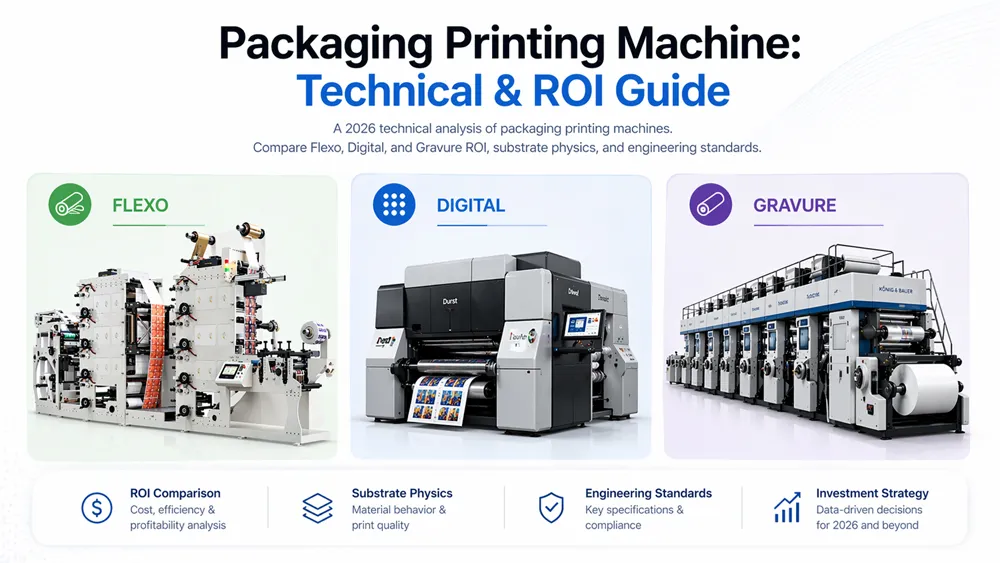
The industry is currently dominated by four primary technologies, each catering to specific market segments:
- Flexo Printing Machines: The industry workhorse. Known for its high speed and ability to print on almost any substrate, from thin films to thick corrugated boards.
- Digital Printing Machines: Best for ultra-short runs and personalized packaging, though with higher consumable costs.
- Rotogravure Machines: Ideal for extremely long runs of flexible packaging, but with high initial plate costs and longer setup times.
- Offset Printing: Primarily used for high-quality folding cartons and paper-based packaging.
For most modern converters who require a balance of high-volume efficiency and medium-run flexibility, flexo printing machines remain the most recommended investment for 2026 due to their rapid ROI and lower operational costs.
2. Key Features to Look for in 2026
When auditing a packaging printing machine, look beyond the mechanical speed. In the modern era, "Intelligence" is what saves money:
- Full Servo Synchronization: Eliminates mechanical gears, drastically reducing maintenance and improving registration accuracy to ±0.1mm.
- UV & LED-UV Curing Systems: Essential for instant drying on non-porous films like BOPP and PE, allowing for immediate inline finishing.
- Automated Tension Control: Critical for handling the thinner, eco-friendly substrates that are becoming the global standard.
- Quick Changeover Systems: Look for machines that allow for rapid sleeve or anilox roller changes to minimize downtime between jobs.
3. Selection Guide: How to Choose the Right Machine?
The "best" machine is the one that matches your specific order structure. Use the following criteria for your evaluation:
A. Substrate Type
If you are printing on plastic films (BOPP, PET, PE), a flexo printing machine with a chilled impression roller is mandatory to prevent material stretching. For paper and cardboard, water-based flexo or offset systems are highly effective.
B. Average Run Length
Do you mostly run 2,000-meter jobs or 200,000-meter jobs? $$Profitability = \frac{Total\ Revenue\ -\ (Setup\ Waste + Material\ Cost)}{Production\ Time}$$ Flexo technology has moved into the "Sweet Spot" where it is now competitive for both short and long runs due to reduced setup waste.
C. Color Requirements
Basic logistics labels may only need 2 colors, but premium cosmetic packaging often requires 8 or 9 color stations to accommodate CMYK, multiple spot colors, and specialty varnishes.
4. Comparison Matrix: Packaging Technology ROI
| Feature | Flexo Printing | Digital Printing | Rotogravure |
|---|---|---|---|
| Setup Cost | Low to Moderate | Near Zero | Very High |
| Production Speed | Very High (up to 200m/min) | Slow to Moderate | Extremely High |
| Substrate Range | Universal (Films/Paper/Foil) | Limited | Primarily Films |
| Ink Cost | Lowest (UV/Water-based) | Very High | Moderate (Solvent) |
Conclusion: Scaling Your Packaging Business
Investing in a packaging printing machine is a decade-long commitment. For factories aiming to capture the lucrative retail and pharmaceutical markets in 2026, the versatility of flexo printing machines offers the most resilient path forward.
Share this article: