Flatbed Die Cutting: Process, Benefits & Limitations
Flatbed die cutting is a mechanical converting process that uses a flat cutting die and a pressing mechanism to cut materials into specified shapes. In label production, the material is positioned between the cutting tool and a supporting surface, and pressure is applied to create the required label outline.
Flatbed die cutting is used for pressure-sensitive labels, printed label stock and other compatible converting materials. Its suitability depends on the material construction, cutting geometry, tooling arrangement and required production output. Understanding how the process works helps converters evaluate its practical benefits and limitations.
What Is Flatbed Die Cutting?
Flatbed die cutting uses a flat cutting tool that presses against material supported by a cutting plate or opposing surface. Unlike rotary die cutting, which uses cylindrical cutting tools, flatbed systems perform the cutting action through a pressing cycle.
In roll-fed label converting, the web typically advances by a controlled distance, stops or stabilizes for cutting, and then moves to the next position. This intermittent feeding arrangement allows the die to produce repeated shapes along the material web.
Depending on the tooling and material construction, flatbed equipment can perform kiss cutting, which leaves the release liner intact, or through cutting, which separates the complete material construction.
Flatbed and rotary cutting are both forms of mechanical die cutting. Their main difference is how the cutting tool engages with the material, rather than whether one process qualifies as die cutting.
How Does Flatbed Die Cutting Work?
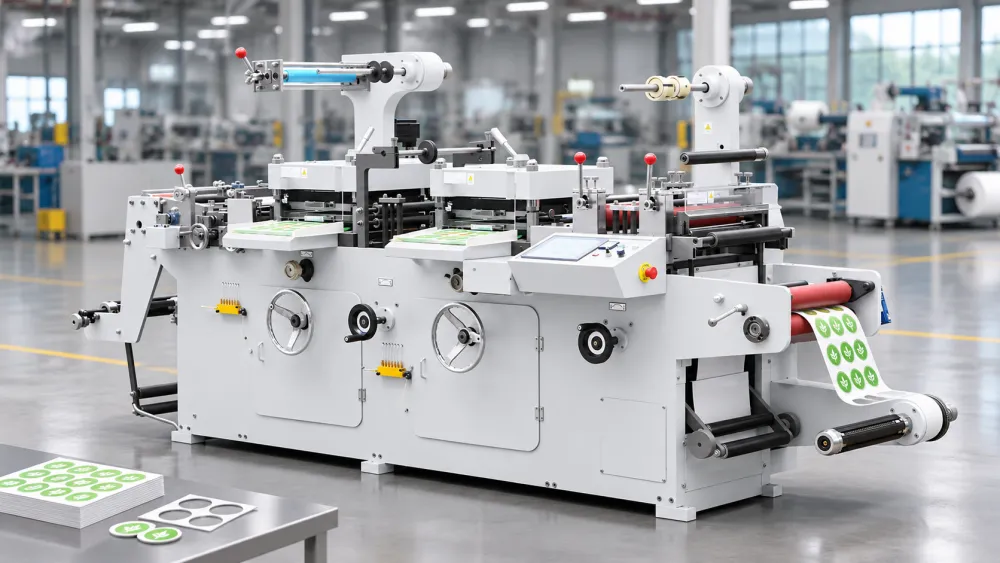
A typical roll-fed flatbed label die cutting process combines controlled material feeding, cutting-position alignment, a pressing cycle and downstream finishing. The exact sequence depends on the machine configuration and whether the material has already been printed.
- Material unwinding and feeding: Printed or unprinted label stock is unwound and guided into the cutting section. The feeding system advances the material according to the required cutting repeat.
- Positioning and registration: For printed labels, registration marks and compatible sensors can be used to align the cutting outline with the artwork. Unprinted materials generally require positioning but not print-to-cut registration.
- Flatbed cutting: The cutting mechanism closes, bringing the die into contact with the material. The tool cuts the specified layers according to the required label shape and cutting depth.
- Tool release and web advancement: After the cutting cycle, the pressing mechanism opens and the material advances to the next cutting position.
- Waste matrix removal: For kiss-cut pressure-sensitive labels, the surrounding face-material waste can be stripped away while the finished labels remain on the release liner.
- Inspection and finishing: Depending on the production line, the converted material may be inspected, slit, counted, sheeted or rewound into finished label rolls.
Not every flatbed die cutting machine includes all these operations. Some systems combine cutting, waste removal and rewinding, while others require separate finishing equipment.
For a broader explanation of how cutting fits into label converting, see our label die cutting process guide.
What Are the Main Components of a Flatbed Die Cutting System?
A flatbed die cutting system combines the cutting tool, pressing mechanism and material-handling components. The design of these systems affects cutting consistency, registration and the range of materials that can be processed.
| Component | Main Function | Production Consideration |
|---|---|---|
| Flat cutting die | Defines the cutting outline and contacts the material during the pressing cycle | Die geometry, cutting-edge condition and material compatibility |
| Pressing mechanism | Applies the force required to perform the cutting operation | Consistent force distribution and correct cutting engagement |
| Cutting plate or supporting surface | Supports the material opposite the cutting tool | Surface condition, alignment and suitability for the cutting method |
| Servo or mechanical feeding system | Advances the material between cutting cycles | Feed-length consistency and material positioning |
| Registration control | Aligns the cutting position with printed artwork when required | Sensor performance, print-mark quality and positioning stability |
| Web tension and guiding system | Maintains controlled material movement through the converting line | Material tracking, stretching and repeat consistency |
| Waste removal system | Separates the surrounding waste matrix from kiss-cut labels | Clean cutting, liner integrity and stable waste handling |
These components must work together. A correctly manufactured die may still produce incomplete cuts or registration errors if the pressing surfaces are misaligned, the feeding system is unstable or the material thickness varies.
For this reason, cutting performance should be evaluated as a complete process rather than by the cutting die or nominal pressing force alone.
Which Materials Can Be Flatbed Die Cut?
Flatbed die cutting can process paper, plastic films and multilayer label materials when the tooling and machine configuration are suitable. Material compatibility depends on the face stock, adhesive, release liner, thickness and required cutting depth—not simply whether the material is paper or film.
| Material | Typical Label Application | Key Cutting Consideration |
|---|---|---|
| Coated paper | Food packaging, retail products and general-purpose labels | Clean edges, adhesive separation and consistent cutting depth |
| Polypropylene (PP) | Beverage, cosmetic and household product labels | Film deformation, adhesive behavior and stable feeding |
| Polyethylene (PE) | Squeeze bottles and flexible-container labels | Material stretching, dimensional stability and registration |
| Polyester (PET) | Durable identification labels and industrial applications | Material toughness, suitable tooling and complete cut separation |
| Specialty laminated labels | Protective, functional and multilayer labels | Combined layer thickness, cutting resistance and liner compatibility |
For pressure-sensitive labels, flatbed equipment may perform kiss cutting to preserve the release liner or through cutting to separate the complete material construction. The appropriate method depends on the finished-label format.
Before processing a new material, converters should test samples using the actual face stock, adhesive and liner combination. Two materials with the same nominal thickness may respond differently because of their stiffness, adhesive properties or layer construction.
What Are the Benefits of Flatbed Die Cutting?
Flatbed die cutting can be useful when a production job requires a defined cutting area, controlled material positioning and tooling suited to the finished shape. Its advantages are application-dependent rather than universal.
Flexible Cutting Shapes and Layouts
Flatbed tooling can produce rectangular, circular, oval and irregular label outlines within the machine's available cutting area. Multiple labels can also be arranged within one cutting cycle, provided the tooling layout and material spacing allow it.
Controlled Positioning for Printed Labels
On machines equipped with suitable registration controls, the web can be positioned before each cutting cycle. This arrangement can support cut-to-print alignment, although the achievable accuracy still depends on sensor performance, feeding stability, material behavior and tooling condition.
Tooling Options for Different Jobs
Flatbed systems can use different die constructions according to the material, cutting geometry and machine design. This provides options for jobs with different outlines or cutting requirements.
However, tooling cost and changeover time should be evaluated for each application. Flatbed tooling is not automatically less expensive or faster to replace than rotary tooling.
Compatibility with Roll-Fed Label Finishing
Suitable flatbed converting systems can combine die cutting with waste matrix removal, slitting and rewinding. This allows pressure-sensitive labels to remain on their release liner and be supplied in finished rolls for downstream application.
These functions depend on the actual equipment configuration and should not be assumed to be standard on every flatbed die cutting machine.
What Are the Limitations of Flatbed Die Cutting?
The main limitations of flatbed die cutting relate to its cutting cycle, available working area, material handling and tooling requirements. These factors become particularly important when evaluating long production runs, large label formats or materials that are sensitive to deformation.
| Limitation | Why It Matters | What to Evaluate |
|---|---|---|
| Intermittent cutting cycle | The material must be positioned and cut during repeated pressing cycles, which can limit throughput for some jobs. | Actual cycle rate, labels per cycle and usable production output |
| Maximum cutting area | The die and cutting station have defined working dimensions. | Label dimensions, layout, web width and available die area |
| Material deformation | Flexible films may stretch or shift during feeding and cutting. | Web tension, material stability and registration performance |
| Tooling and setup | Different label shapes or material constructions may require tooling changes and setup adjustments. | Job frequency, die compatibility, setup waste and changeover time |
| Cutting consistency | Uneven pressing engagement or worn tooling can cause incomplete cuts and liner damage. | Tool condition, supporting surfaces and pressure distribution |
| Production-line balance | Cutting, waste removal and rewinding may operate at different effective rates. | Finished-roll output, downtime and downstream finishing capacity |
A machine's stated cutting frequency should not be treated as its finished-label production rate. One cutting cycle may produce several labels, while setup, material feeding, waste removal and rejected pieces affect actual output.
For example, a die layout producing four labels per cycle has a different theoretical output from a layout producing one label per cycle. The saleable output will be lower whenever downtime or quality losses occur. Production comparisons should therefore use acceptable finished labels or rolls per hour under the intended operating conditions.
What Affects Flatbed Die Cutting Accuracy?
Flatbed die cutting accuracy depends on tooling condition, cutting engagement, material positioning and the stability of the label stock. These factors affect different quality requirements, including finished-label dimensions, cut-to-print registration and cutting-depth consistency.
For pressure-sensitive labels, a correctly shaped cut is not sufficient if the adhesive remains connected or the release liner is damaged. Quality checks should therefore examine both the finished label and its backing.
Common Flatbed Die Cutting Problems and Troubleshooting
| Production Problem | Possible Causes | What to Check First |
|---|---|---|
| Incomplete label cutting | Insufficient cutting engagement, worn die edges or material thickness variation | Inspect the cut outline, tooling condition and consistency across the cutting area |
| Release liner scoring or breakage | Excessive cutting penetration, uneven pressure or unsuitable liner construction | Examine the liner beneath the cut and check the cutting setup |
| Cut-to-print misregistration | Incorrect feed positioning, sensor problems or material movement | Check registration marks, feed repeat and whether the error is consistent or intermittent |
| Uneven cutting across the die | Tool mounting errors, uneven pressing engagement or supporting-surface wear | Compare samples from different positions within the cutting area |
| Labels lifting during waste removal | Incomplete separation, adhesive bridging or unsuitable stripping conditions | Inspect the cut before adjusting waste tension or stripping geometry |
| Distorted label shapes | Material stretching, unstable feeding or unsuitable cutting conditions | Check web tension, material stability and finished dimensions |
Increasing cutting pressure is not a universal solution. It may improve an incomplete cut but can also damage the release liner or accelerate tooling wear. Mechanical inspection and adjustment should follow the equipment manufacturer's safety procedures.
When assessing cutting accuracy, converters should compare samples against the approved label drawing and material specification. A numerical tolerance should be confirmed for the actual machine, tooling and production conditions rather than assumed for all flatbed systems.
Where Is Flatbed Die Cutting Used in Label Production?
Flatbed die cutting is used in roll-fed and sheet-fed converting applications where the tooling, cutting area and production arrangement match the finished product. In pressure-sensitive label production, it can create shaped labels while retaining the release liner for subsequent handling.
| Application | Typical Requirement | Production Consideration |
|---|---|---|
| Product identification labels | Consistent outlines and readable printed information | Cut-to-print registration and finished dimensions |
| Cosmetic and household labels | Custom shapes and clean edges | Film stability, adhesive behavior and liner integrity |
| Barcode and logistics labels | Repeatable label spacing and reliable dispensing | Web positioning, matrix removal and roll finishing |
| Specialty adhesive labels | Material-specific cutting depth and defined shapes | Tooling suitability and multilayer construction |
As one equipment example, Henghao's flatbed label die cutting machine uses a flatbed cutting arrangement with servo feeding and photoelectric registration control. Its listed configuration also includes waste removal and rewinding functions for roll-fed label converting.
This is an example of a specific machine configuration, not a universal specification for flatbed die cutting equipment. Buyers should confirm material compatibility, cutting dimensions and required finishing functions for their own production jobs.
Flatbed Die Cutting: Frequently Asked Questions
Can Flatbed Die Cutting Handle Both Printed and Unprinted Labels?
Yes, when the machine and tooling are compatible with the material. Printed labels require the cutting position to align with the artwork, while unprinted materials generally do not need print-to-cut registration. Both applications still require consistent feeding, suitable tooling and stable cutting conditions.
Does Every Label Shape Require a Different Flatbed Die?
Not necessarily. A die may be reused when the cutting outline, dimensions and layout remain compatible with the job. Changes to the label shape or cutting arrangement may require a different die. Material changes can also require setup adjustments even when the original tooling remains suitable.
Can Flatbed Die Cutting Produce Labels on Continuous Rolls?
Yes. Roll-fed flatbed systems can kiss cut pressure-sensitive labels while retaining the release liner. With suitable waste removal and rewinding equipment, the converted labels can be supplied as finished rolls for downstream labeling operations.
Is Flatbed Die Cutting Suitable for Long Production Runs?
It can be, depending on the required output and job configuration. Long-run suitability should be evaluated using acceptable finished labels per hour, tooling durability, setup time and downstream capacity. For some continuous, high-volume jobs, rotary cutting may provide a more suitable production arrangement, but the comparison is application-dependent.
How Can Buyers Estimate Flatbed Die Cutting Output?
A basic estimate starts with the number of labels produced per cutting cycle multiplied by the effective number of cycles per minute. The result must then be adjusted for operating time, rejected labels and other production losses.
For example, if a job produces four labels per cycle at an effective rate of 100 cycles per minute, the theoretical output is 400 labels per minute. This is an illustrative calculation, not a verified machine performance figure. Actual saleable output must be established through production trials.
Final Considerations: When Does Flatbed Die Cutting Make Sense?
Flatbed die cutting is a practical option when the material construction, label shape, cutting area and production requirements match the machine's capabilities. Its main strengths lie in controlled cutting cycles, configurable tooling and compatibility with suitable label-finishing workflows.
Its limitations should also be considered, particularly the cutting cycle, available working area, tooling requirements and effective production output. The best process is the one that consistently produces acceptable labels under the intended operating conditions.
Before selecting equipment, converters should prepare the actual label material, finished dimensions, cutting layout, production volume and roll specifications. These details provide a more reliable basis for evaluating label die cutting machines than comparing nominal machine speeds alone.
Share this article: