Kiss Cut vs Die Cut: Key Differences for Labels
Kiss cut and die cut labels may look similar, but the main difference is how deeply the material is cut. A kiss cut passes through the label face material and adhesive while keeping the release liner intact. A through cut passes through the complete material construction, including the backing when one is present.
This distinction affects how labels are supplied, peeled, applied and handled during production. For label converters and packaging buyers, the right choice depends on the finished format, label material and application method.
What Is the Difference Between Kiss Cut and Die Cut?
Kiss cutting leaves the backing intact, while through cutting separates the complete material into individual shapes. Both methods can create custom outlines, but they produce different finished formats.
One important terminology point: kiss cutting is itself a type of die cutting when a physical die is used. In sticker terminology, however, "die cut" commonly refers to a fully cut, individual sticker. This article uses "die cut" in that common through-cutting sense when comparing finished stickers.
| Comparison | Kiss Cut | Die Cut (Through Cut) |
|---|---|---|
| Cutting depth | Through the face material and adhesive | Through the complete material construction |
| Release liner | Remains continuous | Cut to the finished outline when present |
| Finished format | Labels on a continuous liner, roll or sheet | Individual pieces or separated shapes |
| Peeling | Labels peel from the surrounding liner | Individual stickers are peeled from their own backing |
| Typical use | Roll labels, sticker sheets and automatic labeling | Individual promotional stickers and cut pieces |
| Production concern | Protecting the liner while achieving a clean cut | Complete separation and clean finished edges |
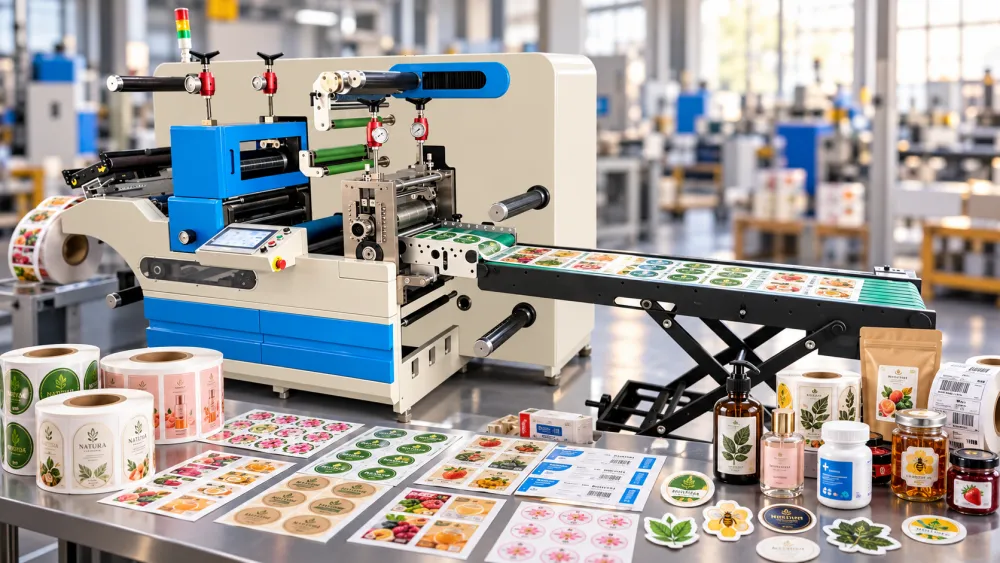
What Is Kiss Cutting?
Kiss cutting is a controlled-depth cutting process that separates the adhesive label from the surrounding face material without cutting through its release liner.
A typical pressure-sensitive label construction contains a face material, an adhesive layer, a release coating and a backing liner. The cutting tool must pass through the face material and adhesive while preserving enough liner strength for subsequent handling.
This is especially important for roll labels. After the surrounding waste matrix is removed, the finished labels remain positioned on a continuous backing web for inspection, rewinding or automatic application.
What Is a Die Cut Sticker?
In common sticker terminology, a die cut sticker is an individual sticker whose outer edge follows its custom shape. The backing is usually cut to the same outline, rather than remaining as a larger rectangular sheet.
Die cut stickers are often used for promotional giveaways, branding, decorative applications and individually distributed products. Their appearance is defined by the finished outline, which may follow a logo, illustration or other irregular shape.
A custom shape does not automatically mean that a sticker has been through-cut. Kiss cut stickers can also have complex outlines; the difference is whether the surrounding backing remains intact.
How Does Cutting Depth Affect Label Quality?
Cutting depth is one of the most important differences between the two processes. With kiss cutting, insufficient penetration can leave uncut adhesive or face material. Excessive penetration can score, weaken or break the release liner.
For through cutting, the tool must separate the complete construction cleanly. Incomplete cuts can leave connecting fibers or film bridges, while excessive cutting force may cause unnecessary tool wear or damage supporting surfaces.
Cutting performance depends on the material construction, tool condition, pressure distribution, adhesive behavior and web stability. A setting that works for one label stock should not automatically be used for another.
Kiss Cut vs Die Cut: Which Is Better for Roll Labels?
Kiss cutting is generally the appropriate choice for pressure-sensitive labels supplied on continuous rolls. The intact release liner keeps labels positioned and allows the web to pass through finishing and labeling operations.
Through cutting is more suitable when the required product is an individual piece rather than a continuous roll of peelable labels.
For a broader explanation of the manufacturing sequence, see our label die cutting process guide.
Which Cutting Method Works Best for Different Label Applications?
| Application | Recommended Format | Reason |
|---|---|---|
| Beverage bottle labels | Kiss cut on rolls | Supports continuous dispensing and automatic labeling |
| Cosmetic product labels | Kiss cut on rolls or sheets | Keeps shaped adhesive labels on a removable backing |
| Barcode and logistics labels | Kiss cut on rolls | Maintains a continuous liner for dispensing |
| Sticker sheets | Kiss cut | Allows multiple stickers to peel from one backing sheet |
| Individual promotional stickers | Through cut | Produces separate pieces with custom outer shapes |
| Specialty cut components | Depends on the final assembly | May require retained carriers or complete separation |
These are typical format choices, not universal rules. The final cutting method should match the material construction, delivery format and application process.
Does Kiss Cutting Produce More Waste Than Die Cutting?
Not necessarily. Material waste depends more on label shape, spacing, nesting, web width and finishing requirements than on the cutting-depth category alone.
Kiss-cut label rolls often require removal of the surrounding face-material matrix while retaining the liner. Through-cut products may require separation and collection of individual pieces, along with removal of the surrounding trim.
The more useful comparison is the total material consumed per acceptable finished label, including setup waste and rejected pieces.
What Problems Can Occur During Kiss Cutting?
Common problems include labels that do not peel cleanly, liner scoring, adhesive bridging, label lifting and unstable waste removal.
These defects do not always have the same cause. Cutting depth, adhesive properties, liner strength, tool wear and web tension can interact, so production teams should identify the actual failure before changing settings.
When labels lift together with the surrounding waste, refer to our matrix stripping troubleshooting guide for a more detailed diagnosis.
How Should Label Converters Choose Between Kiss Cutting and Through Cutting?
Start with the required finished product, not the cutting equipment. A practical decision should consider the following:
- Delivery format: Will labels be supplied on rolls, sheets or as individual pieces?
- Application method: Will the labels be applied automatically or manually?
- Material construction: What face material, adhesive and liner are being processed?
- Shape and spacing: Are the outlines simple, intricate or closely nested?
- Quality requirements: What limits apply to liner damage, incomplete cuts and finished-edge defects?
- Finishing workflow: Will the product require matrix removal, inspection, slitting or rewinding?
For industrial roll-label production, the cutting method must also be compatible with the converting workflow. Henghao Machinery provides label die cutting machines for different material and production requirements.
Kiss Cut vs Die Cut: Frequently Asked Questions
Is Kiss Cutting the Same as Die Cutting?
No, they are not strictly opposing processes. Kiss cutting describes how deeply the material is cut, while die cutting describes cutting with a shaped die. A die can perform either kiss cutting or through cutting. In sticker discussions, "die cut" is often used informally to describe a fully separated sticker.
Can Kiss Cut Stickers Have Custom Shapes?
Yes. Kiss cut stickers can have circles, logos, irregular contours and other custom shapes. The cutting tool follows the required outline while leaving the backing intact. A rectangular sticker sheet may therefore contain several individually shaped stickers that can be peeled off separately.
Are Die Cut Stickers Always Better Quality?
No. Neither finished format is automatically better. Quality depends on clean cutting, suitable materials, adhesive performance and the intended application. A kiss cut roll label may be ideal for automatic labeling, while an individual through-cut sticker may be better for distribution or promotional use.
Can the Same Cutting Equipment Perform Both Methods?
Some industrial cutting systems can support both kiss cutting and through cutting, depending on their tooling, pressure adjustment, supporting surfaces and material-handling configuration. Compatibility must be verified for the specific machine and material rather than assumed from the machine category alone.
Why Is the Release Liner Important in Kiss Cutting?
The release liner supports the labels during waste removal, transport, inspection and dispensing. If the liner is weakened by excessive cutting depth, it may break or create problems during rewinding and application. Preserving liner integrity is therefore a key requirement for stable roll-label production.
Final Takeaway: Choose the Cut That Matches the Finished Label
Kiss cutting is the preferred approach when adhesive labels need to remain on a continuous backing for peeling, rewinding or automatic application. Through cutting is appropriate when the complete material must be separated into individual finished shapes.
The correct choice depends on how the label will be delivered and used, as well as the material construction and required cutting quality. Understanding these differences helps converters avoid unnecessary waste, handling problems and unsuitable finishing arrangements.
Share this article: